
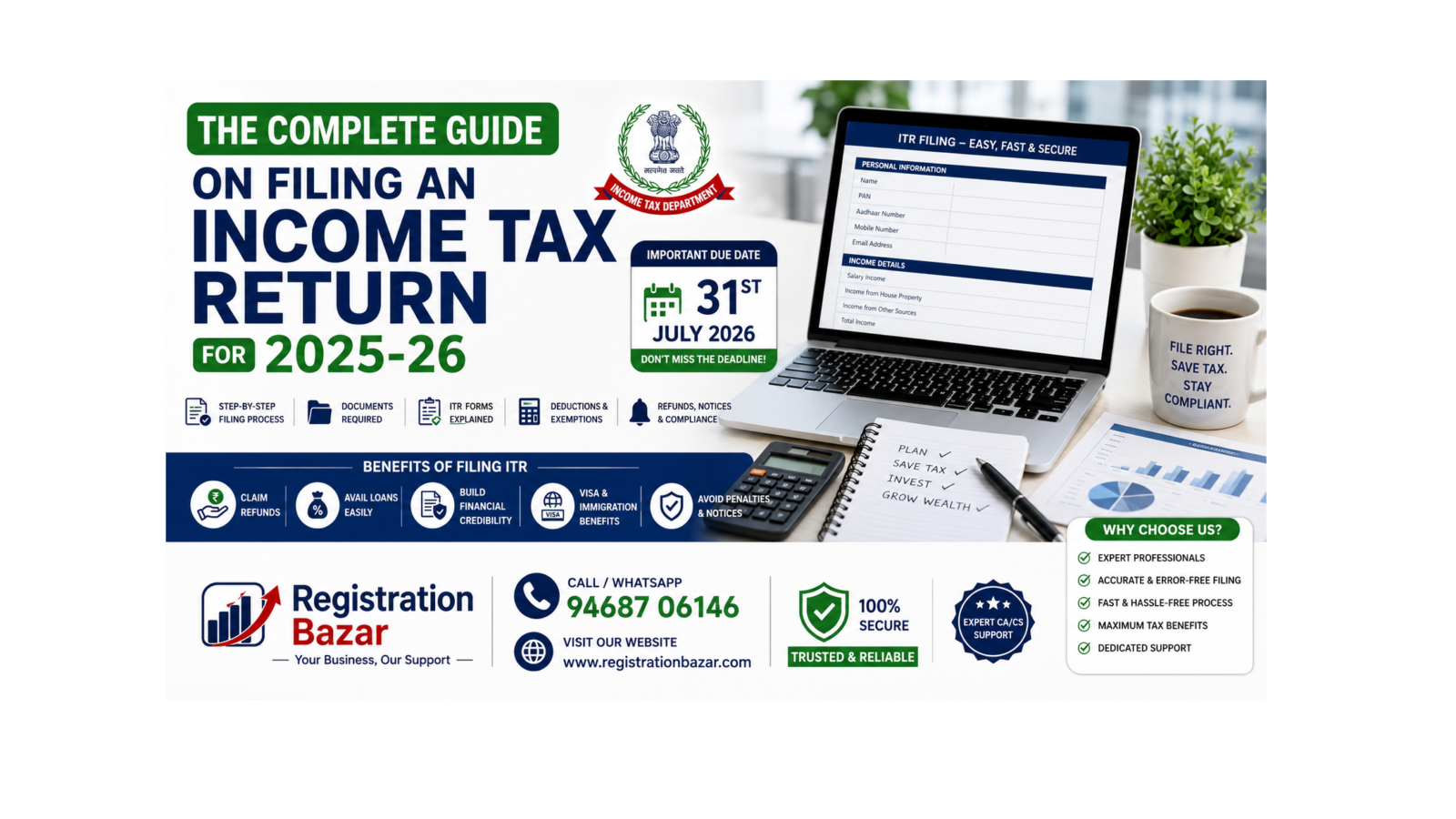
Everything You Need to Know About Income Tax Return Filing in India
By Registration Bazar | Tax & Compliance Experts | Kota, Rajasthan
Learn everything about Income Tax Return (ITR) Filing for Assessment Year 2026-27, including eligibility, due dates, ITR forms, required documents, filing process, deductions, FAQs, and expert ITR filing services in Kota, Rajasthan.
Filing an Income Tax Return (ITR) is one of the most important financial responsibilities for every eligible taxpayer in India. Whether you are a salaried employee, business owner, freelancer, professional, pensioner, or investor, filing your ITR accurately and on time helps you remain compliant with the Income-tax Act, 1961 while also providing several financial benefits.
Apart from fulfilling a legal obligation, filing an ITR serves as proof of income, helps claim tax refunds, allows eligible losses to be carried forward, improves your financial credibility, and supports applications for loans, visas, and various government registrations.
With every assessment year, taxpayers are required to understand the applicable due dates, choose the correct ITR form, report income accurately, and reconcile information with Form 26AS, AIS, and TIS to avoid notices or delays in processing.
This comprehensive guide explains everything you need to know about Income Tax Return Filing for Assessment Year (AY) 2026–27, including eligibility, documents required, due dates, ITR forms, filing process, common mistakes, FAQs, and expert tips to ensure hassle-free tax compliance.
Table of Contents
- What is an Income Tax Return (ITR)?
- Financial Year vs Assessment Year
- Why is Filing an ITR Important?
- Who Should File an ITR?
- Who is Not Required to File an ITR?
- Benefits of Filing an ITR
- Due Dates for AY 2026–27
- Documents Required
- Types of ITR Forms
- Which ITR Form Should You Choose?
- Step-by-Step Process of Filing an ITR
- Old Tax Regime vs New Tax Regime
- Common Deductions Available
- Common Mistakes to Avoid
- Details That Should Not Mismatch
- Penalties for Late Filing
- Income Tax Refund Process
- Frequently Asked Questions
- Why Choose Registration Bazar?
- Contact Us
What is an Income Tax Return (ITR)?
An Income Tax Return (ITR) is a prescribed form through which a taxpayer reports their income, deductions, exemptions, taxes paid, and tax liability or refund to the Income Tax Department of India for a particular financial year.
The Income Tax Return is filed electronically through the official Income Tax e-Filing Portal.
The information reported in an ITR generally includes:
- Personal Information
- PAN & Aadhaar Details
- Residential Status
- Salary Income
- Business or Professional Income
- Income from House Property
- Capital Gains
- Income from Other Sources
- Exempt Income
- Deductions Claimed
- Taxes Paid (TDS, TCS, Advance Tax, Self-Assessment Tax)
- Refund Details
- Bank Account Information
Once the return is successfully filed and verified, the Income Tax Department processes the return and issues a refund (if applicable) or confirms the tax liability.
Financial Year vs Assessment Year
Many taxpayers are confused between the terms Financial Year (FY) and Assessment Year (AY). Understanding the difference is essential before filing your return.
| Particular | Meaning |
|---|---|
| Financial Year (FY) | The year in which income is earned. |
| Assessment Year (AY) | The year immediately following the Financial Year in which the income is assessed and taxed. |
Example
| Particular | Period |
|---|---|
| Financial Year | 1 April 2025 – 31 March 2026 |
| Assessment Year | 1 April 2026 – 31 March 2027 |
Therefore, the income earned during FY 2025–26 is reported in the Income Tax Return for AY 2026–27.
Why is Filing an Income Tax Return Important?
Many people believe that filing an Income Tax Return is only necessary if tax is payable. However, an ITR serves multiple purposes beyond tax compliance.
Timely filing of an ITR helps:
- Comply with the provisions of the Income-tax Act, 1961.
- Claim refunds of excess TDS or advance tax paid.
- Carry forward eligible business and capital losses.
- Build financial credibility.
- Provide documentary proof of income.
- Facilitate loan approvals and higher credit limits.
- Support visa applications for many countries.
- Avoid interest, penalties, and notices from the Income Tax Department.
- Maintain a clean tax compliance history.
- Support business growth and financial planning.
Who Should File an Income Tax Return?
The requirement to file an ITR depends on various factors, including income level, taxpayer category, residential status, and other conditions specified under the Income-tax Act.
Generally, the following persons should file an Income Tax Return, wherever applicable:
Salaried Individuals
Employees receiving salary, pension, allowances, bonuses, or other employment-related income.
Business Owners
Individuals carrying on proprietorship businesses, traders, manufacturers, retailers, wholesalers, and service providers.
Professionals
Doctors, Chartered Accountants, Company Secretaries, Architects, Engineers, Consultants, Lawyers, Interior Designers, and other professionals.
Freelancers
Individuals earning income through freelancing, digital services, online platforms, content creation, or consultancy assignments.
Partners in Firms
Partners earning remuneration, interest, or profit share from partnership firms.
Investors
Individuals earning income from:
- Shares
- Mutual Funds
- Bonds
- Debentures
- Dividends
- Capital Gains
House Property Owners
Persons earning rental income from one or more house properties.
Individuals with Foreign Income or Foreign Assets
Resident taxpayers holding foreign assets or earning income outside India.
Companies, LLPs, Trusts, and Other Entities
As required under the Income-tax Act.
Who is Not Required to File an Income Tax Return?
In certain cases, filing an ITR may not be mandatory under the Income-tax Act, subject to satisfaction of prescribed conditions.
Examples include:
- Individuals whose income is below the prescribed basic exemption limit and who are not covered by any mandatory filing provisions.
- Certain senior citizens eligible for relaxation under the applicable provisions.
- Other persons specifically exempt under the Income-tax Act or notifications issued by the Central Government.
Note: Even if filing is not mandatory, voluntarily filing an ITR can provide significant financial and procedural benefits, such as establishing proof of income, claiming refunds, and maintaining a tax compliance record.
Benefits of Filing an Income Tax Return
Filing your Income Tax Return offers numerous legal, financial, and practical advantages.
| Benefit | Description |
|---|---|
| ✅ Legal Compliance | Complies with the Income-tax Act, 1961. |
| 💰 Claim Tax Refund | Receive refunds of excess TDS or advance tax paid. |
| 📈 Carry Forward Losses | Carry forward eligible capital and business losses to future years. |
| 🏦 Loan Approval | Banks and financial institutions often require ITRs while evaluating loan applications. |
| 🌍 Visa Applications | Many embassies require ITR acknowledgements as proof of financial stability. |
| 📄 Proof of Income | Accepted by banks, government departments, and financial institutions. |
| 🏢 Business Growth | Helpful while applying for tenders, registrations, and funding. |
| 🛡️ Avoid Notices | Accurate and timely filing reduces the chances of notices and penalties. |
| 💼 Financial Credibility | Demonstrates responsible financial and tax compliance behaviour. |
| 📊 Better Financial Planning | Helps analyse income, deductions, taxes paid, and investments. |
Due Dates for Filing Income Tax Return (AY 2026–27)
The due date for filing an Income Tax Return depends upon the category of taxpayer and whether audit or transfer pricing provisions are applicable.
| Category of Taxpayer | Due Date |
|---|---|
| Individuals, HUFs and other non-audit cases | 31 July 2026 |
| Specified non-audit business/profession cases (as notified) | 31 August 2026 |
| Companies and Audit Cases | 31 October 2026 |
| Transfer Pricing Cases (Section 92E) | 30 November 2026 |
| Belated / Revised Return | 31 December 2026 |
Step 1 – Collect All Required Documents
Before starting the filing process, gather all the necessary documents to avoid errors and delays.
Keep the following documents ready:
- PAN Card
- Aadhaar Card
- Form 16 (for salaried individuals)
- Form 26AS
- Annual Information Statement (AIS)
- Taxpayer Information Summary (TIS)
- Salary Slips
- Bank Statements
- Interest Certificates
- Home Loan Certificate (if applicable)
- Investment Proofs
- Capital Gain Statements
- Business Financial Statements (if applicable)
- Advance Tax & Self-Assessment Tax Challans
Pro Tip: Missing documents can lead to incorrect reporting of income or deductions. Always ensure that your records are complete before filing.
Step 2 – Verify Your Personal Information
Ensure that all your personal details are accurate and updated.
Verify the following:
| Particular | Check |
|---|---|
| PAN | ✔ |
| Aadhaar Number | ✔ |
| Name | ✔ |
| Date of Birth | ✔ |
| Mobile Number | ✔ |
| Email ID | ✔ |
| Address | ✔ |
| Residential Status | ✔ |
| Bank Account Details | ✔ |
| IFSC Code | ✔ |
Step 3 – Reconcile Your Income
Compare your income with the information available in:
- Form 16
- Form 26AS
- AIS
- TIS
- Salary Slips
- Bank Statements
- Capital Gain Statements
- Rental Income Records
- Business Accounts
Every source of income should be reported correctly.
Step 4 – Choose the Correct ITR Form
Selecting the correct Income Tax Return form is extremely important.
| Type of Taxpayer | Recommended ITR Form |
|---|---|
| Salaried Individual | ITR-1 |
| Capital Gain | ITR-2 |
| Business Owner | ITR-3 |
| Freelancer | ITR-3 / ITR-4 |
| Presumptive Taxation | ITR-4 |
| LLP | ITR-5 |
| Company | ITR-6 |
| Trust | ITR-7 |
Step 5 – Compute Your Total Income
Calculate income under all applicable heads:
Salary
- Basic Salary
- HRA
- Bonus
- Perquisites
- Allowances
House Property
- Self-Occupied Property
- Let-Out Property
- Rental Income
Business or Profession
- Business Income
- Professional Income
- Presumptive Income
Capital Gains
- Shares
- Mutual Funds
- Property
- Gold
- Bonds
Income from Other Sources
- Bank Interest
- Dividend
- Family Pension
- FD Interest
Step 6 – Claim Eligible Deductions
After calculating Gross Total Income, claim deductions available under the Income-tax Act.
Examples include:
- Eligible investments under Section 80C
- Health insurance premium under Section 80D
- Home loan interest (subject to applicable provisions)
- NPS contributions
- Education loan interest
- Donations to eligible institutions
Ensure all deduction claims are supported by documentary evidence.
Step 7 – Calculate Tax Liability
After considering income and eligible deductions:
- Calculate tax payable.
- Adjust TDS, TCS, Advance Tax, and Self-Assessment Tax already paid.
- Identify whether any balance tax is payable or a refund is due.
Step 8 – Pay Outstanding Tax (If Any)
If there is any balance tax payable, pay it before filing the return and retain the challan details for reporting in the ITR.
Step 9 – Login to the Income Tax e-Filing Portal
Access the official Income Tax e-Filing Portal using your PAN/Aadhaar and password.
Choose:
- Assessment Year – AY 2026–27
- Applicable ITR Form
- Filing Status
Step 10 – Fill the Income Tax Return
Enter all required information carefully, including:
- Personal Details
- Income Details
- Tax Paid
- Deductions
- Bank Details
- Verification Information
Step 11 – Review Your Return
Before submission, thoroughly review the return.
Cross-check the following:
| Particular | Verify Against |
|---|---|
| Salary | Form 16 |
| TDS | Form 26AS |
| Interest Income | AIS |
| Dividend | AIS |
| Capital Gain | Broker Statement |
| Bank Details | Passbook |
| PAN | PAN Card |
| Aadhaar | Aadhaar Card |
Step 12 – Submit the Return
After verification, submit the Income Tax Return electronically.
Step 13 – Complete e-Verification
A return is considered valid only after e-Verification.
Available methods include:
- Aadhaar OTP
- Net Banking
- Electronic Verification Code (EVC)
- Bank Account Verification
- Demat Account Verification
- Digital Signature Certificate (DSC), where applicable
Step 14 – Download the Acknowledgement
After successful e-Verification:
- Download the ITR-V / Acknowledgement.
- Save a copy for your records.
Quick Filing Workflow
Collect Documents
        │
        ▼
Verify PAN & Aadhaar
        │
        ▼
Download Form 26AS, AIS & TIS
        │
        ▼
Select Correct ITR Form
        │
        ▼
Calculate Income
        │
        ▼
Claim Eligible Deductions
        │
        ▼
Calculate Tax Liability
        │
        ▼
Pay Balance Tax (if any)
        │
        ▼
Fill the Return
        │
        ▼
Review Carefully
        │
        ▼
Submit Return
        │
        ▼
Complete e-Verification
        │
        ▼
Download ITR-V
Old Tax Regime vs New Tax Regime
Choosing the appropriate tax regime is an important decision while filing your Income Tax Return. The choice depends on your income level, eligible deductions, and overall tax planning.
| Particular | Old Tax Regime | New Tax Regime |
|---|---|---|
| Tax Rates | Higher | Lower |
| Deductions | Available | Limited |
| Section 80C | Yes | Not generally available |
| Section 80D | Yes | Not generally available |
| Home Loan Interest (Self-occupied) | Yes (subject to conditions) | Not generally available |
| Suitable For | Taxpayers with significant deductions | Taxpayers with fewer deductions |
Important: The applicable regime and available deductions are subject to the provisions in force for AY 2026–27. Taxpayers should evaluate both regimes before making a choice, where an option is available.
Common Deductions Available Under the Income-tax Act
The following deductions may be available, subject to eligibility and applicable provisions of the Income-tax Act:
| Section | Nature of Deduction |
|---|---|
| Section 80C | Eligible investments such as PPF, EPF, ELSS, Life Insurance Premium, Principal Repayment of Home Loan, Tuition Fees, etc. |
| Section 80CCD | Contribution to the National Pension System (NPS) |
| Section 80D | Health Insurance Premium |
| Section 80E | Interest on Education Loan |
| Section 24(b) | Interest on Home Loan (subject to applicable conditions) |
| Section 80G | Donations to eligible charitable institutions |
| Section 80TTA / 80TTB | Deduction on eligible savings account interest (subject to conditions) |
Note: Deduction limits, conditions, and eligibility vary by section. Always refer to the applicable provisions for AY 2026–27 and retain supporting documents.
Common Mistakes to Avoid While Filing an ITR
Avoid these frequent mistakes to ensure a smooth filing experience:
- Selecting the wrong ITR form.
- Reporting incorrect PAN or Aadhaar details.
- Omitting bank interest income.
- Failing to disclose dividend income.
- Ignoring entries in AIS or Form 26AS.
- Claiming deductions without supporting documents.
- Entering incorrect bank account details.
- Choosing the wrong assessment year.
- Not reporting capital gains.
- Forgetting to include rental income.
- Filing after the due date without considering the consequences.
- Forgetting to complete e-Verification.
Details That Should Never Mismatch
One of the most common reasons for receiving notices from the Income Tax Department is a mismatch between the information reported in the Income Tax Return and the data available with the department.
| Particular | Verify With |
|---|---|
| PAN | PAN Card |
| Aadhaar | Aadhaar Card |
| Name | PAN Database |
| Date of Birth | PAN Database |
| Salary | Form 16 |
| TDS | Form 26AS |
| Interest Income | AIS |
| Capital Gains | Broker Statement |
| Rental Income | Rent Records |
| Business Income | Books of Accounts |
| Bank Details | Passbook |
| IFSC Code | Bank Records |
| Deductions | Investment Proofs |
| Residential Status | Passport/Travel Records (if applicable) |
Consequences of Filing an Incorrect ITR
An incorrect or incomplete return may lead to:
- Notice from the Income Tax Department.
- Delay in processing the return.
- Delay in receiving the refund.
- Additional tax demand, if applicable.
- Interest and penalties under the Income-tax Act.
- Requirement to file a revised return, where permitted.
Income Tax Refund Process
If the total tax paid by you exceeds your actual tax liability, you may be eligible for an income tax refund.
Refund Process
- File your Income Tax Return.
- Complete e-Verification.
- The Income Tax Department processes your return.
- The refund amount, if determined, is credited to your pre-validated bank account.
Note: The time taken for processing and issuing refunds varies depending on the accuracy of the return and departmental processing timelines.
Frequently Asked Questions (FAQs)
Below are some of the most commonly asked questions about Income Tax Return (ITR) filing. These answers are intended to provide general guidance. Taxpayers should consider their individual circumstances and the applicable provisions of the Income-tax Act, 1961.
1. What is an Income Tax Return (ITR)?
An Income Tax Return (ITR) is a prescribed form through which taxpayers report their income, deductions, taxes paid, and tax liability or refund to the Income Tax Department for a particular financial year.
2. What is the difference between Financial Year (FY) and Assessment Year (AY)?
- Financial Year (FY): The year in which income is earned.
- Assessment Year (AY): The year immediately following the Financial Year in which the income is assessed and taxed.
For example:
- FY: 2025–26
- AY: 2026–27
3. Who should file an Income Tax Return?
Individuals, HUFs, firms, LLPs, companies, trusts, and other eligible taxpayers who satisfy the conditions prescribed under the Income-tax Act should file an Income Tax Return.
4. Is filing an ITR mandatory if my income is below the basic exemption limit?
In certain cases, filing may not be mandatory if your income is below the applicable basic exemption limit and no other mandatory filing conditions apply. However, voluntary filing can provide benefits such as claiming refunds, establishing proof of income, and maintaining a tax compliance record.
5. What are the benefits of filing an ITR?
Some key benefits include:
- Legal compliance
- Claiming tax refunds
- Carry forward of eligible losses
- Proof of income
- Loan approvals
- Visa applications
- Financial credibility
- Avoiding interest and penalties
- Better financial planning
6. Which ITR form should I use?
The correct ITR form depends on factors such as your taxpayer category, residential status, and sources of income. Refer to the comparison table in this guide or consult a tax professional if you are unsure.
7. Can I file my ITR myself?
Yes. Eligible taxpayers can file their return online through the Income Tax e-Filing Portal. If your income involves multiple sources, business income, or complex transactions, professional assistance may help ensure accurate reporting.
8. What documents are required for filing an ITR?
Commonly required documents include:
- PAN Card
- Aadhaar Card
- Form 16
- Form 26AS
- AIS
- TIS
- Bank Statements
- Investment Proofs
- Home Loan Certificate (if applicable)
- Capital Gain Statements (if applicable)
9. What is Form 26AS?
Form 26AS is a consolidated tax credit statement containing details of TDS, TCS, advance tax, self-assessment tax, and certain other tax-related information.
10. What are AIS and TIS?
- AIS (Annual Information Statement): Provides comprehensive details of your financial transactions reported to the Income Tax Department.
- TIS (Taxpayer Information Summary): Summarises key information available in AIS.
Both should be reconciled before filing your return.
11. Can I revise my Income Tax Return?
Yes. If you discover an error after filing your return, you may file a revised return within the time permitted under the Income-tax Act, subject to the applicable provisions.
12. What happens if I file the wrong ITR form?
Filing an incorrect ITR form may result in your return being treated as defective, requiring correction or refiling.
13. What happens if I miss the due date?
Missing the due date may lead to consequences such as interest, late filing fees, restrictions on carrying forward certain losses, or delays in refund processing, depending on the applicable provisions.
14. Is e-Verification mandatory?
Yes. A return is generally considered valid only after successful e-Verification through an approved mode.
15. How can I verify my Income Tax Return?
Common methods include:
- Aadhaar OTP
- Net Banking
- Electronic Verification Code (EVC)
- Digital Signature Certificate (where applicable)
16. Can I claim a refund through my ITR?
Yes. If the taxes paid by you exceed your actual tax liability, you may be eligible to claim a refund.
17. How can I check my refund status?
After filing and verification, you can log in to the Income Tax e-Filing Portal to check the processing and refund status.
18. Is Form 16 mandatory?
Form 16 is generally issued by employers to salaried employees. While it is an important document, taxpayers should also reconcile their return with Form 26AS, AIS, and TIS.
19. What if I have income from shares or mutual funds?
Income from shares or mutual funds, including capital gains and dividends, should be reported appropriately in the applicable ITR form.
20. Do I need to report bank interest?
Yes. Interest income from savings accounts, fixed deposits, recurring deposits, and other sources should generally be reported in the return, subject to applicable provisions.
Why Choose Registration Bazar?
At Registration Bazar, we are committed to providing accurate, transparent, and timely tax compliance services to individuals, businesses, professionals, and organisations across India.
Our Services Include
- Income Tax Return (ITR) Filing
- GST Registration & GST Return Filing
- Company Incorporation
- LLP Registration
- Partnership Firm Registration
- MSME (Udyam) Registration
- Trademark Registration
- Digital Signature Certificate (DSC)
- PAN & TAN Services
- TDS Return Filing
- Accounting & Bookkeeping
- ROC Compliance
- Secretarial Compliance
- Tax Advisory
Why Clients Trust Us
| Feature | Benefit |
|---|---|
| ✔ Experienced Professionals | Expert guidance at every stage |
| ✔ Transparent Pricing | No hidden charges |
| ✔ Timely Filing | Avoid penalties and delays |
| ✔ Secure Data Handling | Confidentiality of your financial information |
| ✔ Online & Offline Support | Convenient assistance from anywhere |
| ✔ Personalized Solutions | Tailored advice based on your requirements |
Income Tax Return Filing Services in Kota, Rajasthan
If you are looking for professional Income Tax Return filing services in Kota, Rajasthan, Registration Bazar offers reliable assistance for:
- Salaried Individuals
- Business Owners
- Professionals
- Freelancers
- Start-ups
- Partnership Firms
- LLPs
- Companies
- Investors with Capital Gains
- Individuals with House Property Income
Our experienced professionals assist in selecting the correct ITR form, reconciling Form 26AS, AIS, and TIS, computing tax liability, claiming eligible deductions, filing the return accurately, and ensuring timely compliance.
Whether you require assistance with a simple salary return or a more complex return involving business income or capital gains, we strive to provide an efficient and hassle-free filing experience.
Contact Registration Bazar
Registration Bazar
📍 Office: Kota, Rajasthan
📞 Mobile: +91-94687 06146
🌐 Website: www.registrationbazar.com
⏰ Business Hours: Monday to Saturday | 10:00 AM – 7:00 PM
Final Checklist Before Filing Your ITR
| Checklist | Status |
|---|---|
| PAN linked with Aadhaar | ☐ |
| Correct ITR Form Selected | ☐ |
| Form 26AS Verified | ☐ |
| AIS & TIS Reconciled | ☐ |
| Salary & Other Income Reported | ☐ |
| Capital Gains Reported (if any) | ☐ |
| Eligible Deductions Claimed | ☐ |
| Outstanding Tax Paid | ☐ |
| Bank Account Pre-Validated | ☐ |
| Return Reviewed | ☐ |
| Return Submitted | ☐ |
| e-Verification Completed | ☐ |
| ITR-V Downloaded & Saved | ☐ |
Disclaimer
The information contained in this article is intended for general informational and educational purposes only. Although every effort has been made to ensure accuracy, tax laws, rules, and procedures are subject to amendments, notifications, circulars, and judicial interpretations. Readers should refer to the latest provisions of the Income-tax Act, 1961, applicable rules, notifications, and official guidance before making any tax-related decisions. Professional advice should be obtained for matters involving specific facts or complex tax situations.
About Registration Bazar
Registration Bazar is a professional consultancy based in Kota, Rajasthan, providing comprehensive business registration, taxation, corporate compliance, and legal support services across India. Our team assists entrepreneurs, start-ups, businesses, professionals, and individuals with company incorporation, GST compliance, Income Tax Return filing, trademark registration, ROC filings, secretarial compliance, and allied regulatory services.
We are committed to delivering reliable, timely, and client-focused solutions with an emphasis on compliance, transparency, and professional excellence.
Add a Comment