

INTRODUCTION
ESIC, or the Employees’ State Insurance Corporation, is one of India’s important social-security institutions providing medical and financial protection to eligible employees and their families.
The ESI Scheme is designed to provide protection against contingencies such as sickness, maternity, disablement and death due to employment injury, along with medical care for insured employees and their families.
WHAT IS ESIC?

ESIC stands for Employees’ State Insurance Corporation.
It is a statutory corporation established under the Employees’ State Insurance framework and functions under the administrative control of the Ministry of Labour & Employment, Government of India.
The ESI Scheme provides both:
- Medical benefits
- Cash/social-security benefits
to eligible insured persons and, where applicable, their family members.
The scheme provides protection when an employee faces situations such as illness, maternity, employment injury, disablement or death arising from employment injury.
An employee may lose income because of illness or an employment injury. ESIC helps provide medical care and financial support during specified contingencies.
For employers, ESIC also forms an important part of statutory payroll and labour-law compliance.
WHO IS COVERED UNDER ESIC?

The applicability of ESI depends on the nature of the establishment, number of employees, notified coverage and the applicable wage provisions.
Under the current framework, ESIC has stated that coverage applies to establishments employing 10 or more persons, subject to the applicable provisions and exceptions. ESIC has also stated that establishments having fewer than 10 employees may voluntarily register under the applicable provision. Certain hazardous or life-threatening occupations can have separate coverage requirements.
Historically, the wage ceiling for ESI coverage was increased to Rs. 21,000 per month, with Rs. 25,000 per month for persons with disabilities. However, employers should now also consider the revised definition of “wages” under the Code on Social Security, 2020, which ESIC says has applied from 21 November 2025.
MAJOR BENEFITS OF ESIC
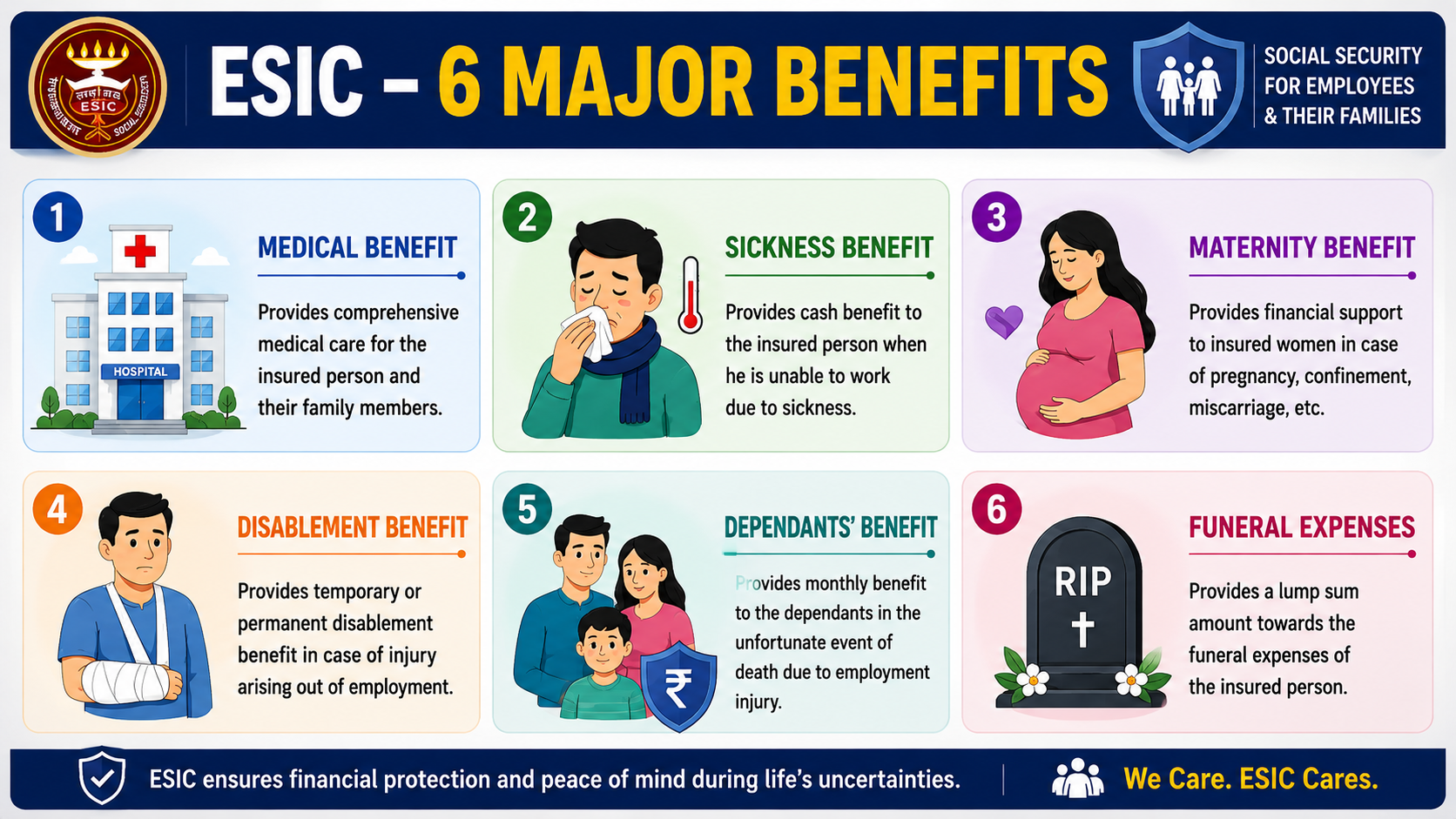
ESIC provides several important social-security benefits to insured persons.
The major benefits include:
- Medical Benefit
- Sickness Benefit
- Maternity Benefit
- Temporary Disablement Benefit
- Permanent Disablement Benefit
- Dependants’ Benefit
- Funeral Expenses
- Other prescribed/need-based benefits
BENEFITS OF ESIC FOR EMPLOYERS
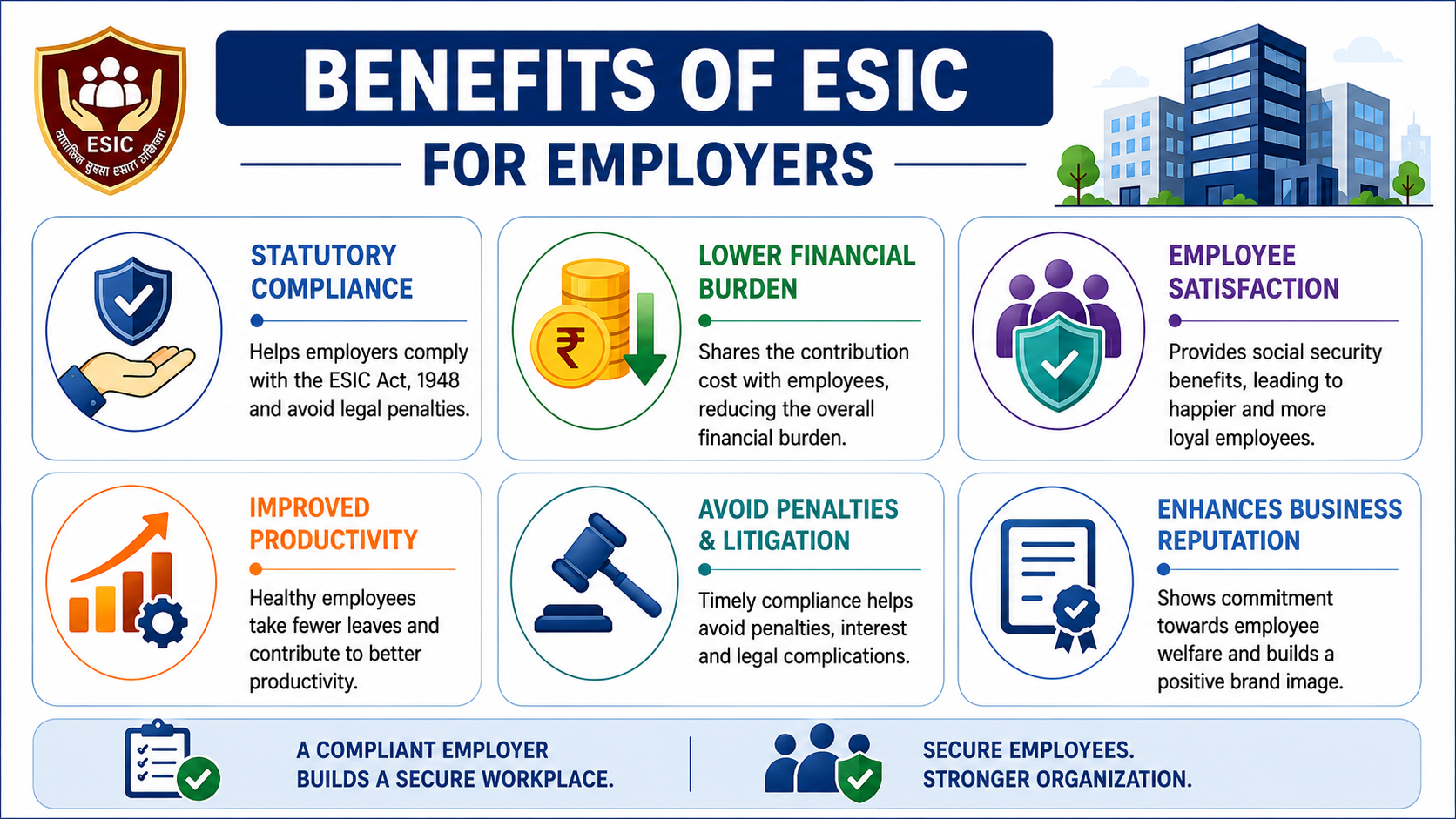
ESIC is primarily a social-security mechanism for employees, but it also provides important practical benefits to employers.
It helps provide financial and medical protection to eligible employees in specified contingencies.
ESIC’s employer guidance also notes that employers covered under the ESI Scheme receive statutory protection in relation to certain liabilities where the ESI framework applies.
Proper ESIC compliance can also help an organisation maintain a systematic payroll and employee-welfare framework.
ESIC CONTRIBUTION – EMPLOYER & EMPLOYEE
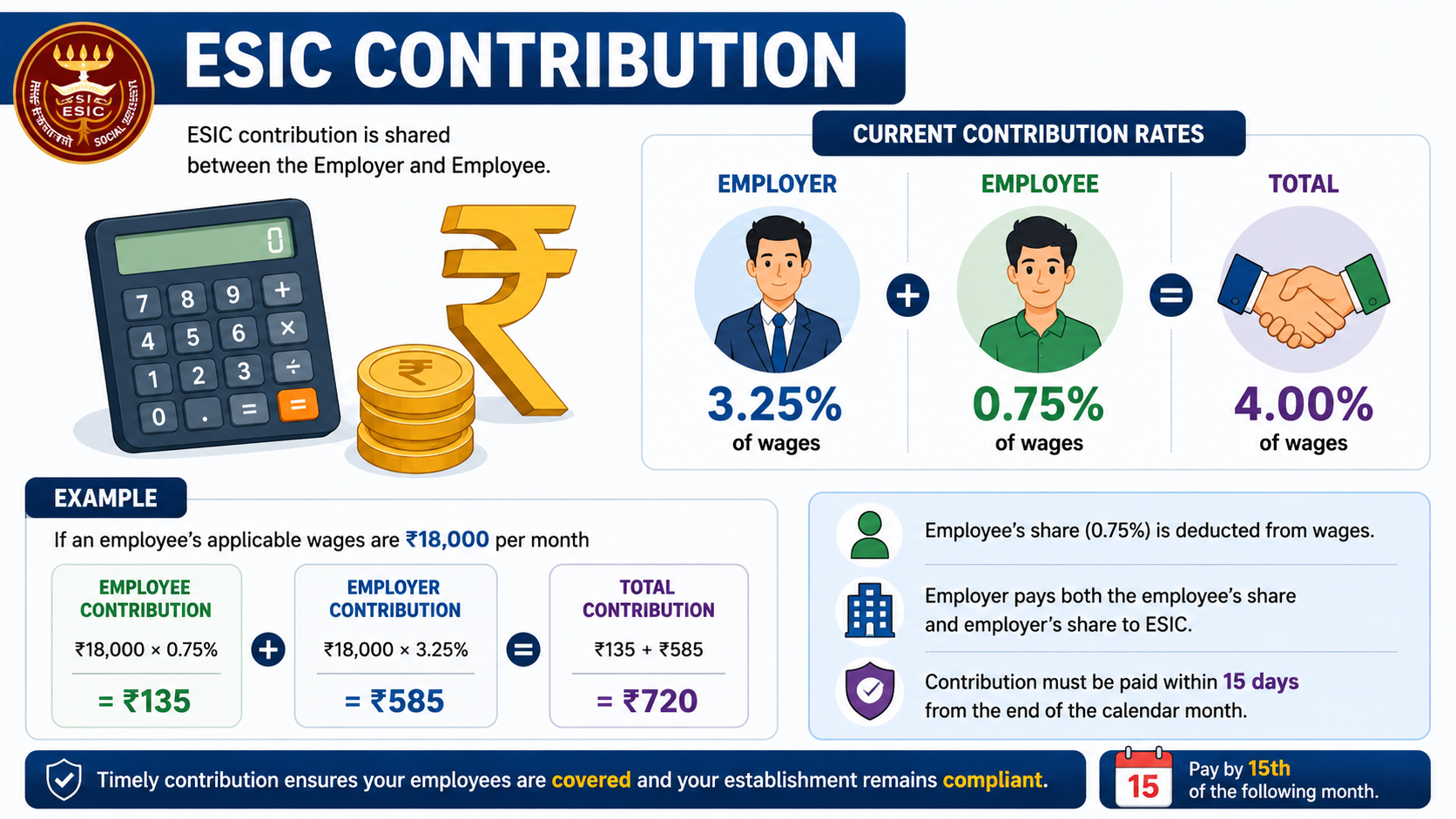
ESIC is financed through contributions from employers and employees.
The currently applicable contribution structure is:
| Contribution | Rate |
| Employee’s contribution | 0.75% |
| Employer’s contribution | 3.25% |
| Total | 4.00% |
The employer deducts the employee’s share from wages and deposits both the employee’s and employer’s contributions with ESIC.
EMPLOYEE CONTRIBUTION EXEMPTION
Employees whose average daily wages are within the prescribed low-wage threshold are exempt from paying the employee’s share, while the employer’s contribution continues to apply as prescribed. ESIC’s current employer guide refers to the Rs. 176 daily-wage threshold for this exemption.
ESIC REGISTRATION
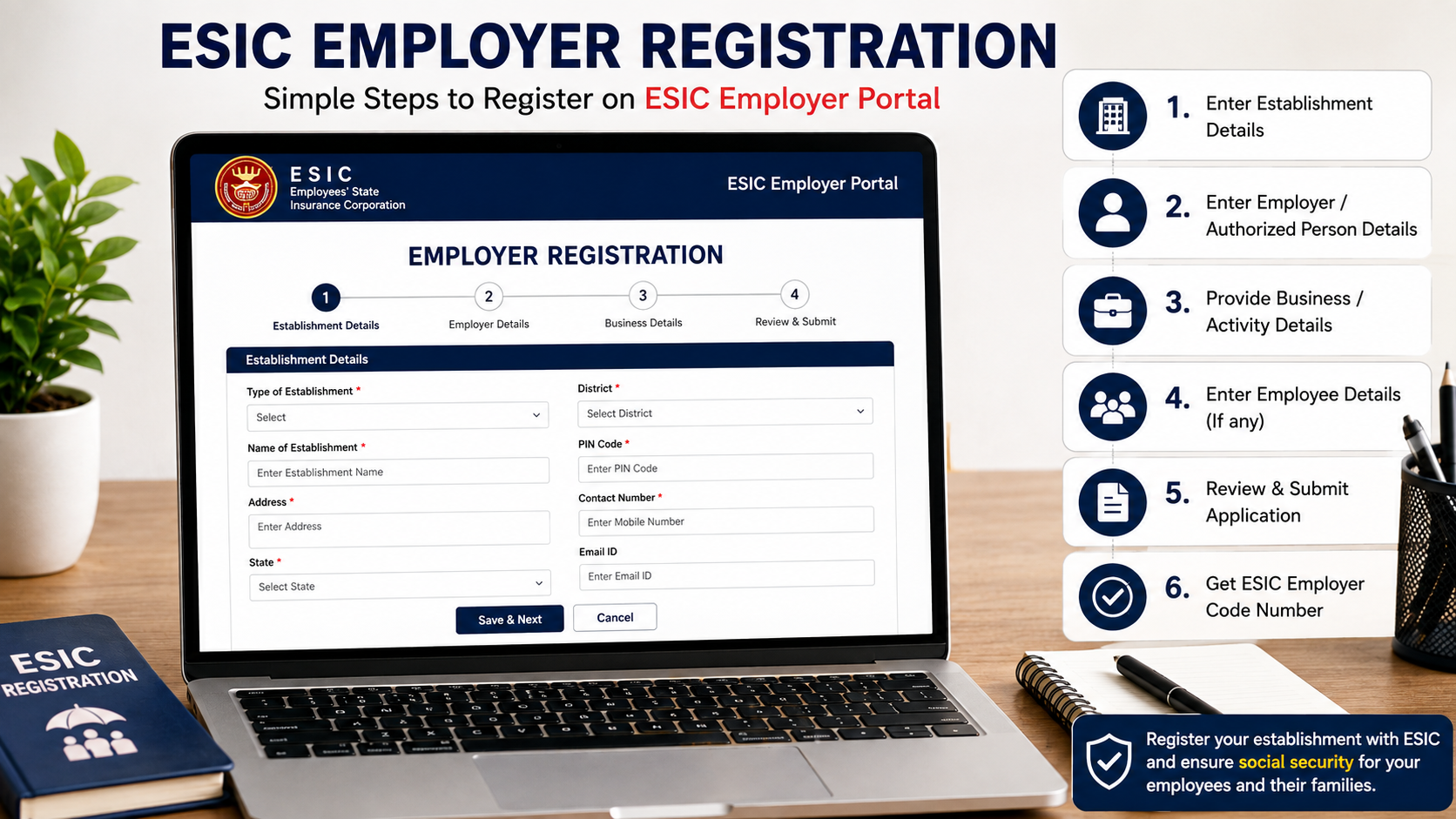
An establishment covered by ESIC provisions is required to obtain registration and comply with the applicable requirements.
ESIC registration is generally carried out online through the ESIC employer portal.
The registration process broadly involves:
Step 1: Create/access the employer account.
Step 2: Select the appropriate establishment/unit details.
Step 3: Enter employer and establishment information.
Step 4: Provide employee-related information.
Step 5: Submit the registration details.
Step 6: Generate/pay the applicable contribution/challan as required.
Step 7: Obtain the ESIC registration number and related registration documentation.
EMPLOYEE REGISTRATION UNDER ESIC
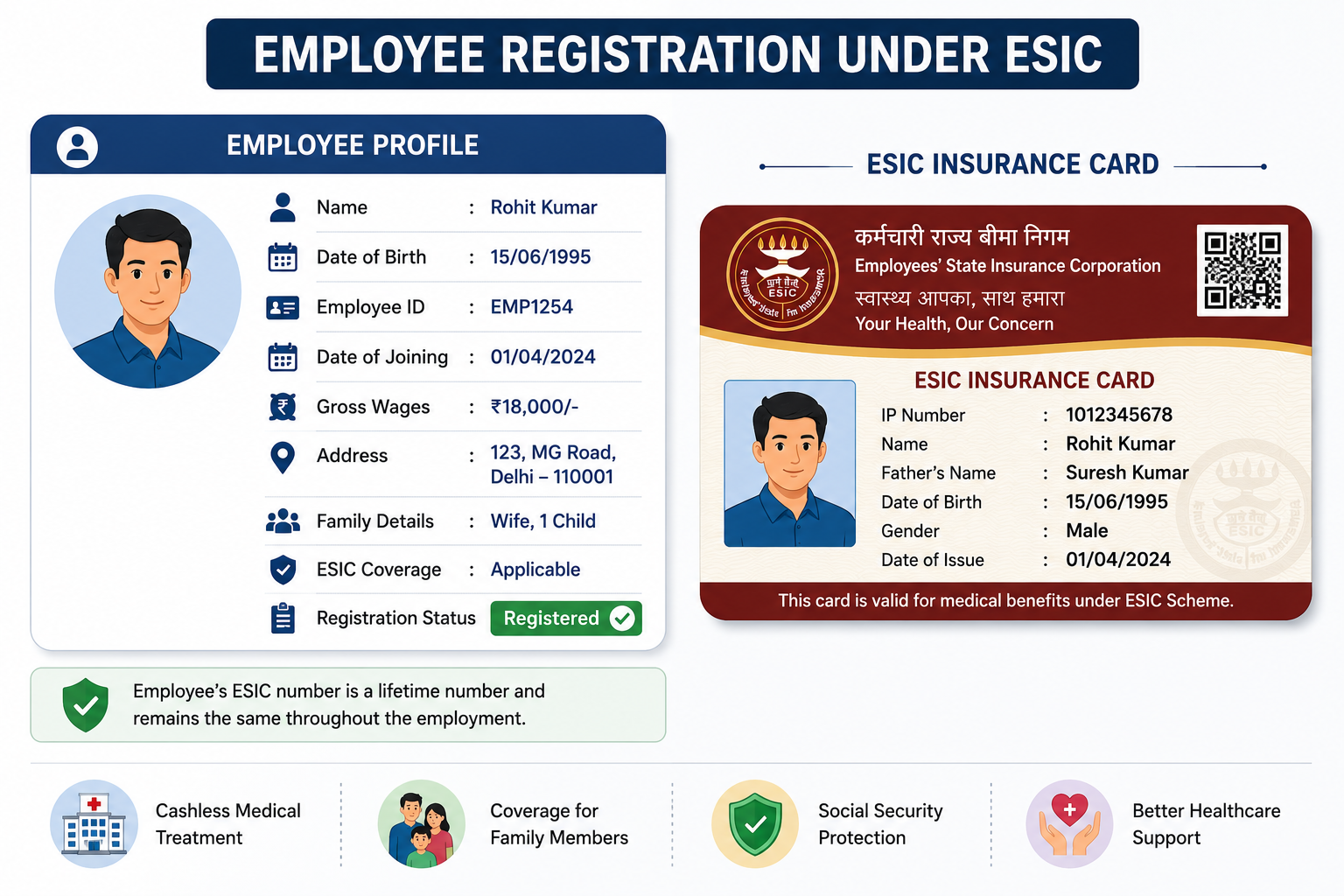
After establishment registration, eligible employees should also be registered under the ESI system.
ESIC’s employer guidance states that coverable employees should be registered on joining and assigned their insurance number.
The employer should ensure that employee information is accurate because incorrect employee data can create problems during benefits, claims or future compliance.
ESIC MONTHLY CONTRIBUTION DUE DATE & RETURN FILING
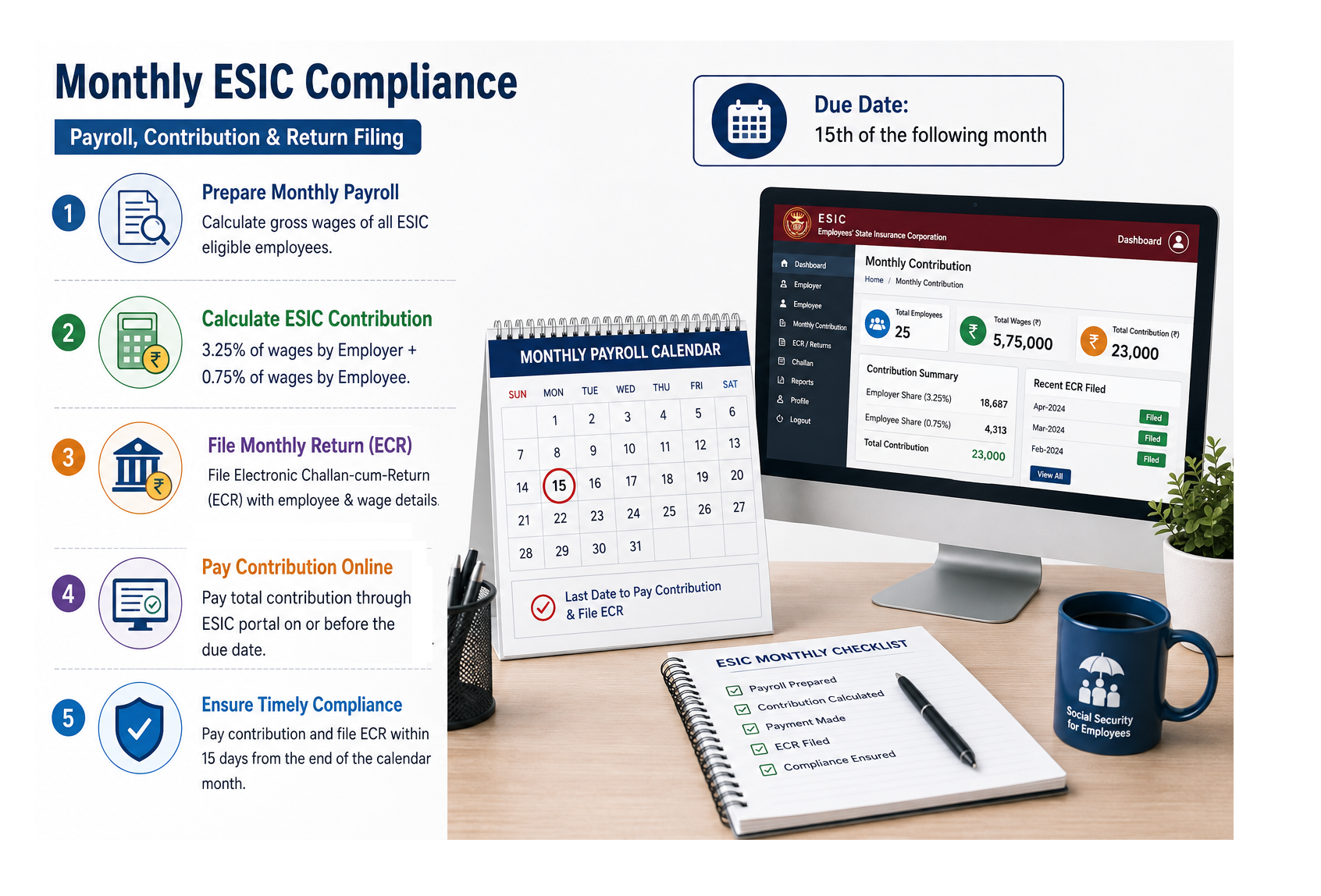
ESIC compliance is not completed merely by obtaining a registration number.
The employer must regularly:
- Calculate applicable ESI wages.
- Determine employee contribution.
- Determine employer contribution.
- Update employee contribution details online.
- Generate the contribution/challan.
- Pay the contribution.
- Maintain payroll and supporting records.
ESIC’s current material states that monthly contribution should be paid within 15 days of the following month.
ESIC compliance involves monthly contribution filing/payment.
The employer needs to provide contribution details for eligible employees and complete the applicable online process.
IS THERE A SEPARATE ANNUAL ESIC RETURN?
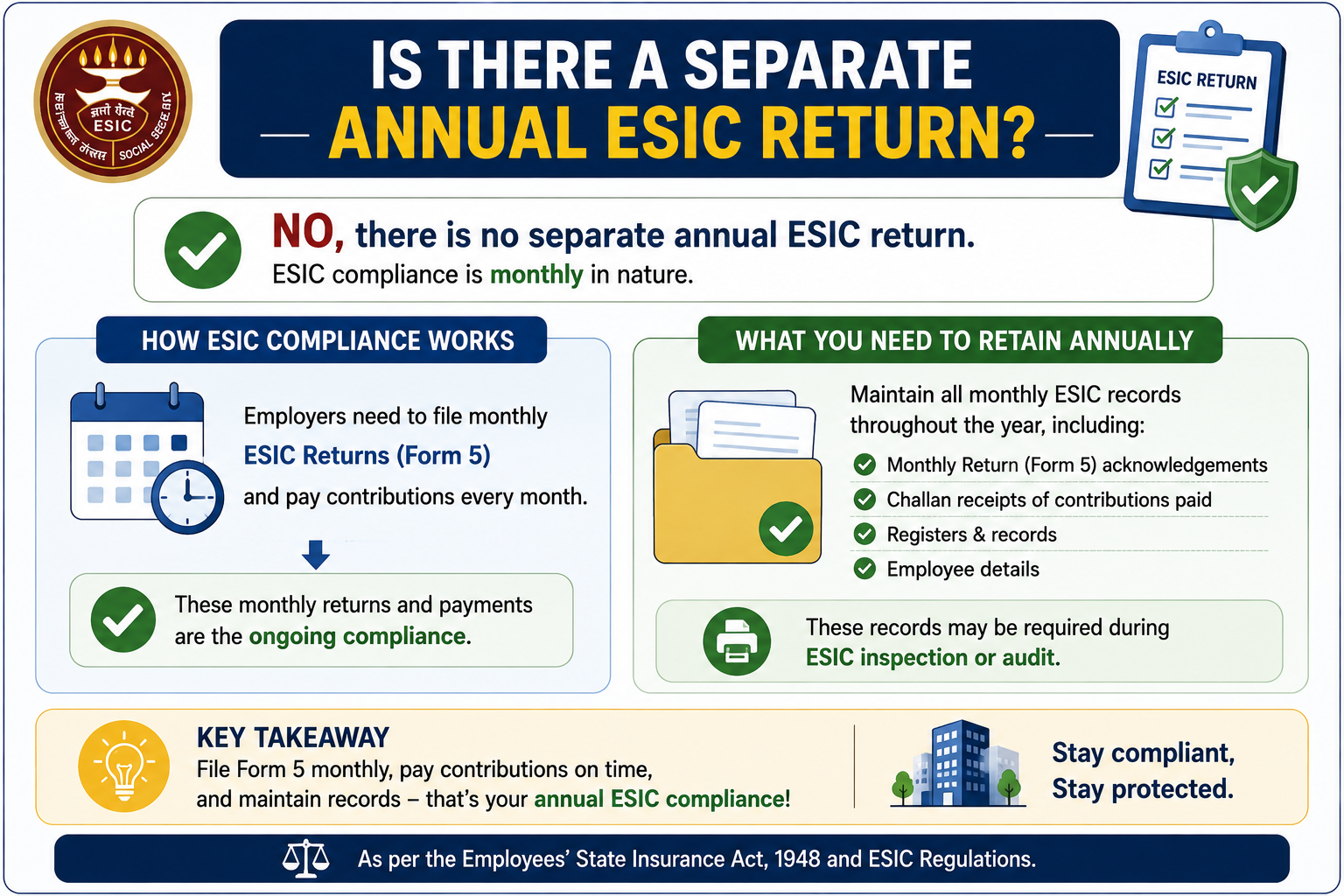
A common confusion is that employers may think that ESIC compliance consists of only one annual return.
The ESIC system operates primarily through monthly contribution filing/payment, with the Return of Contribution being generated online based on monthly contribution information.
ESIC’s employer guidance states that the Return of Contribution is generated online on the basis of monthly contributions filed.
Therefore, employers should focus on accurate monthly payroll data and timely contribution payment rather than waiting for an annual return deadline.
ESIC RECORDS TO BE MAINTAINED
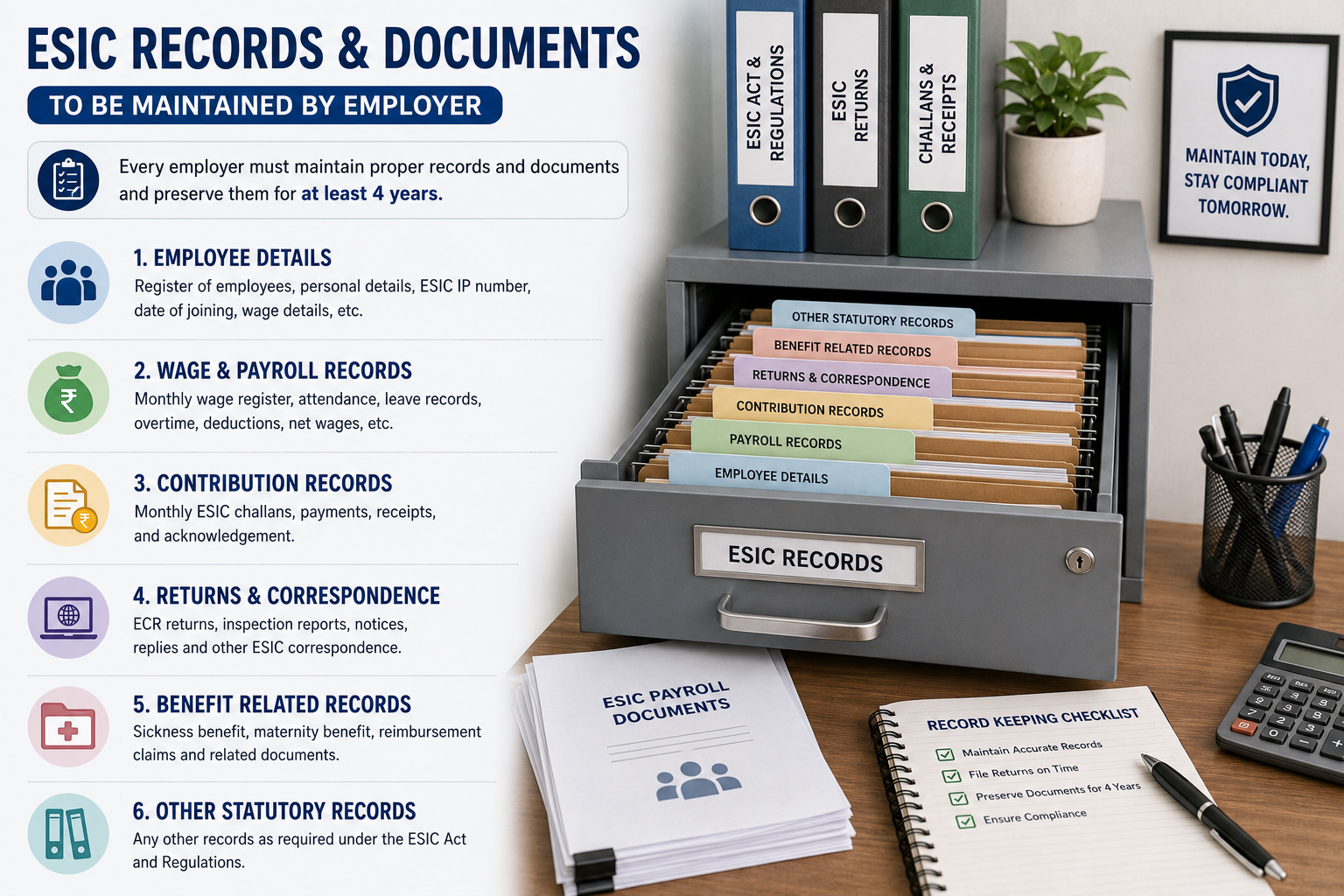
An employer should maintain proper records supporting ESIC compliance.
These can include:
- Employee register
- Muster roll/attendance
- Salary and wage records
- Payroll records
- Contribution details
- Challans/payment records
- Employee insurance details
- Accident records
- Contractor/contract employee records, where applicable
- Other records prescribed under applicable law
WHAT HAPPENS IF ESIC CONTRIBUTION IS NOT PAID ON TIME?
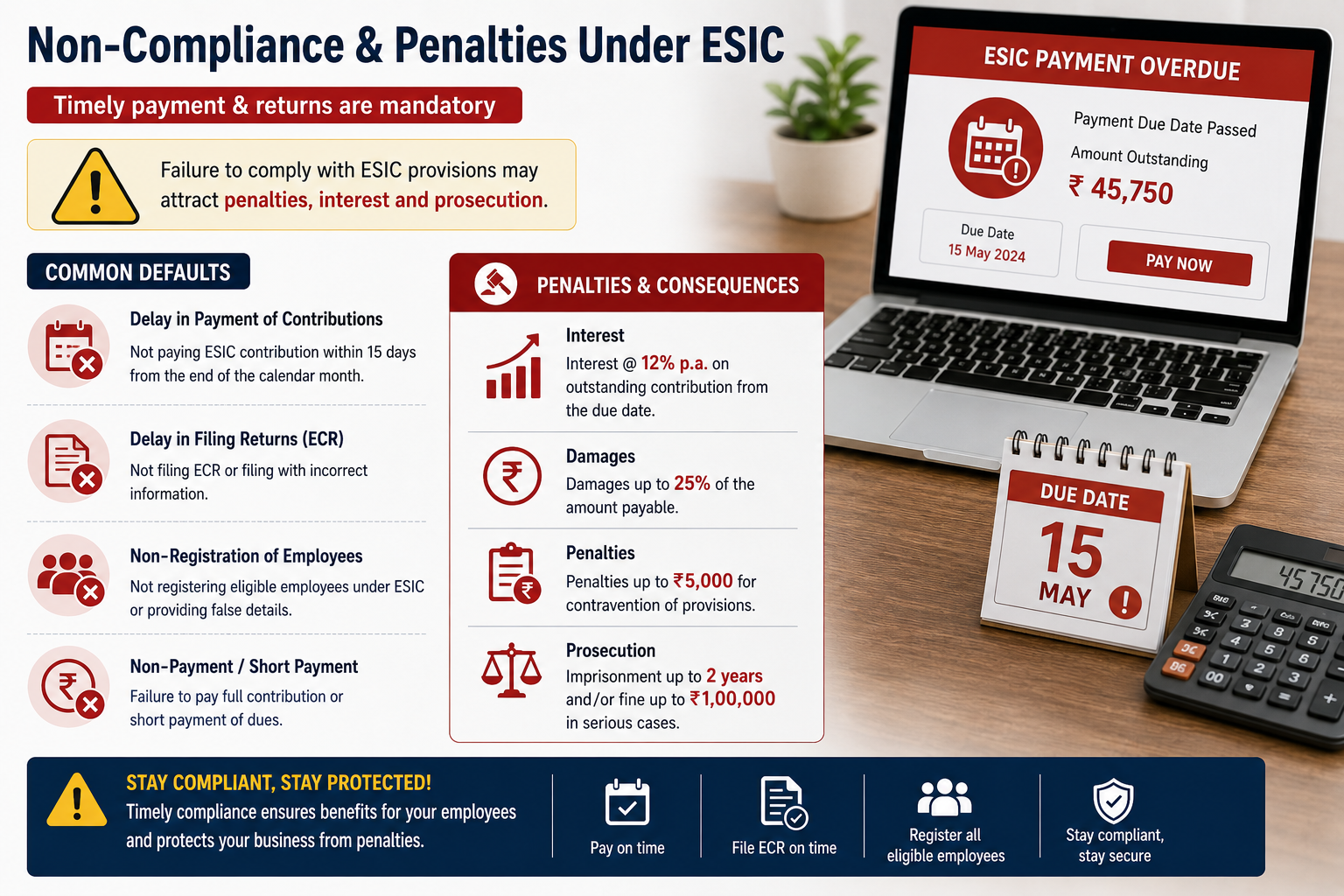
Late payment of ESIC contribution can lead to statutory consequences, including interest and other recovery/action as applicable.
The ESI framework provides for interest on delayed contribution, and ESIC can initiate action against defaulting employers.
Therefore, employers should not treat ESIC payment as an optional monthly administrative activity.
FREQUENTLY ASKED QUESTIONS (FAQS) ON ESIC
1. What is ESIC?
ESIC (Employees’ State Insurance Corporation) is a statutory social-security organisation that provides medical and financial benefits to eligible insured employees and, where applicable, their families.
2. Is ESIC mandatory for every business?
No. ESIC applicability depends on the nature of the establishment, number of employees, notified coverage and applicable wage provisions. Covered establishments are required to comply with ESIC requirements.
3. Are all employees of an ESIC-registered company covered?
No. Registration of an establishment does not automatically mean that every employee is covered. Employee coverage depends on the applicable eligibility and wage provisions.
4. What is the ESIC contribution rate?
The current contribution structure is:
- Employee: 0.75%
- Employer: 3.25%
- Total: 4.00%
5. Is the employee’s ESIC contribution always deducted?
Not necessarily, Employees whose average daily wages fall within the prescribed low-wage threshold may be exempt from paying the employee’s share, while the employer’s contribution continues as applicable.
6. What is the ESIC contribution due date?
The monthly ESIC contribution is generally required to be paid within 15 days of the following month.
Example: Contribution for August → payment by 15 September.
7. Is there a separate annual ESIC return?
ESIC compliance primarily operates through monthly contribution filing and payment. The Return of Contribution is generated online based on the monthly contribution information.
8. How is ESIC registration done?
ESIC registration is generally completed online through the ESIC employer portal. The process broadly involves entering establishment and employer details, providing required information, submitting the registration and obtaining the ESIC registration details.
9. When should an employee be registered under ESIC?
Eligible employees should be registered in accordance with the applicable requirements, generally at the time of joining insurable employment. The employer should ensure that the employee’s information is accurate.
10. What are the benefits of ESIC for employers?
Although ESIC primarily provides social-security benefits to employees, proper ESIC compliance helps employers maintain systematic payroll and employee-welfare processes. ESIC’s employer guidance also provides statutory protection in relation to certain liabilities where the ESI framework applies.
CONCLUSION
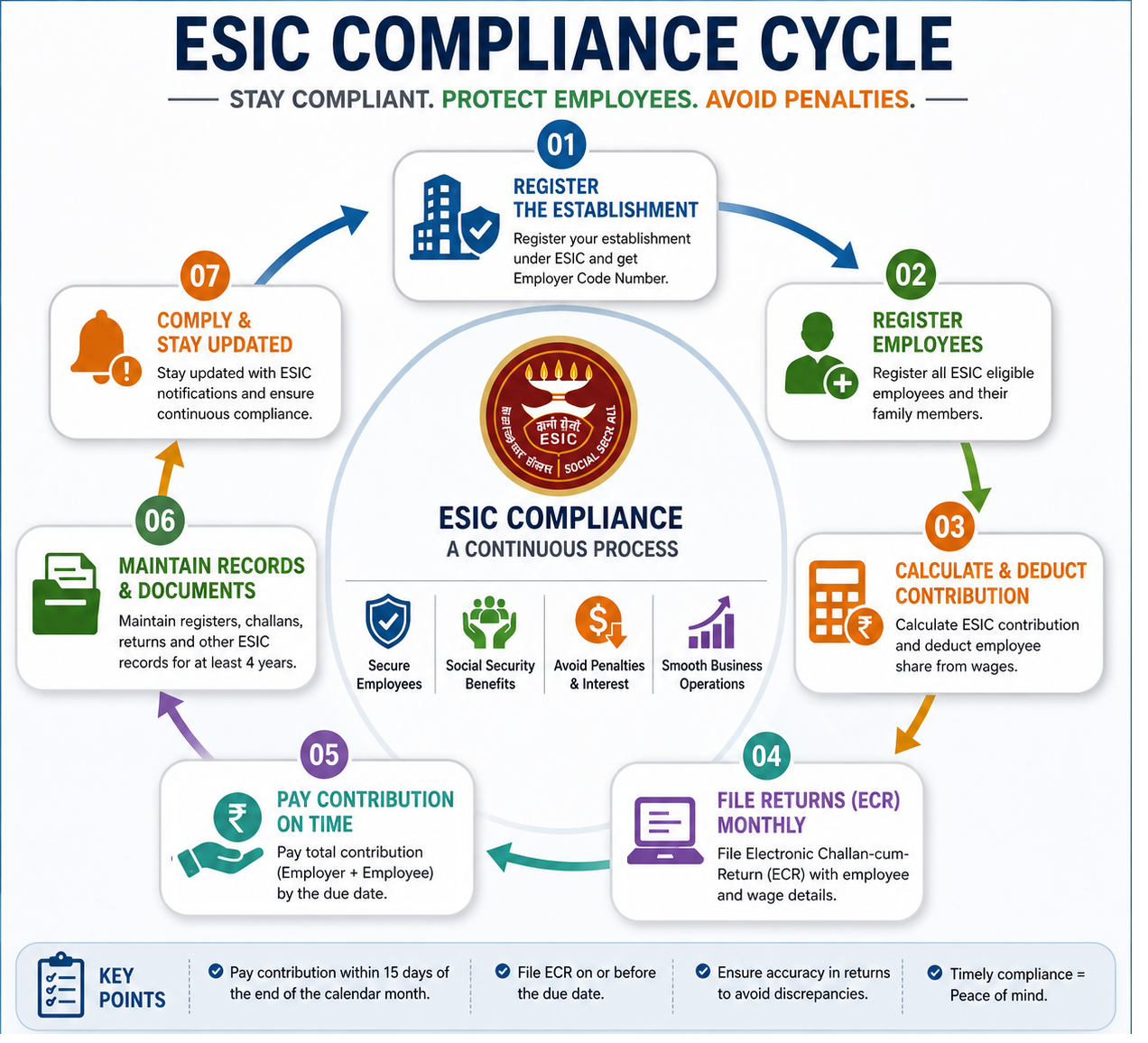
ESIC is an important statutory compliance requirement as well as a significant social-security mechanism for eligible employees.
For an employer, ESIC compliance should be viewed as a continuous monthly process, not merely a one-time registration.
The contribution structure currently provides for 0.75% employee contribution and 3.25% employer contribution, while the applicable wage definition and coverage rules should be examined carefully under the current post-21 November 2025 framework.
Businesses should also periodically check ESIC notifications and circulars because statutory thresholds, benefit amounts, procedures and coverage requirements can change.
FINAL OVERVIEW
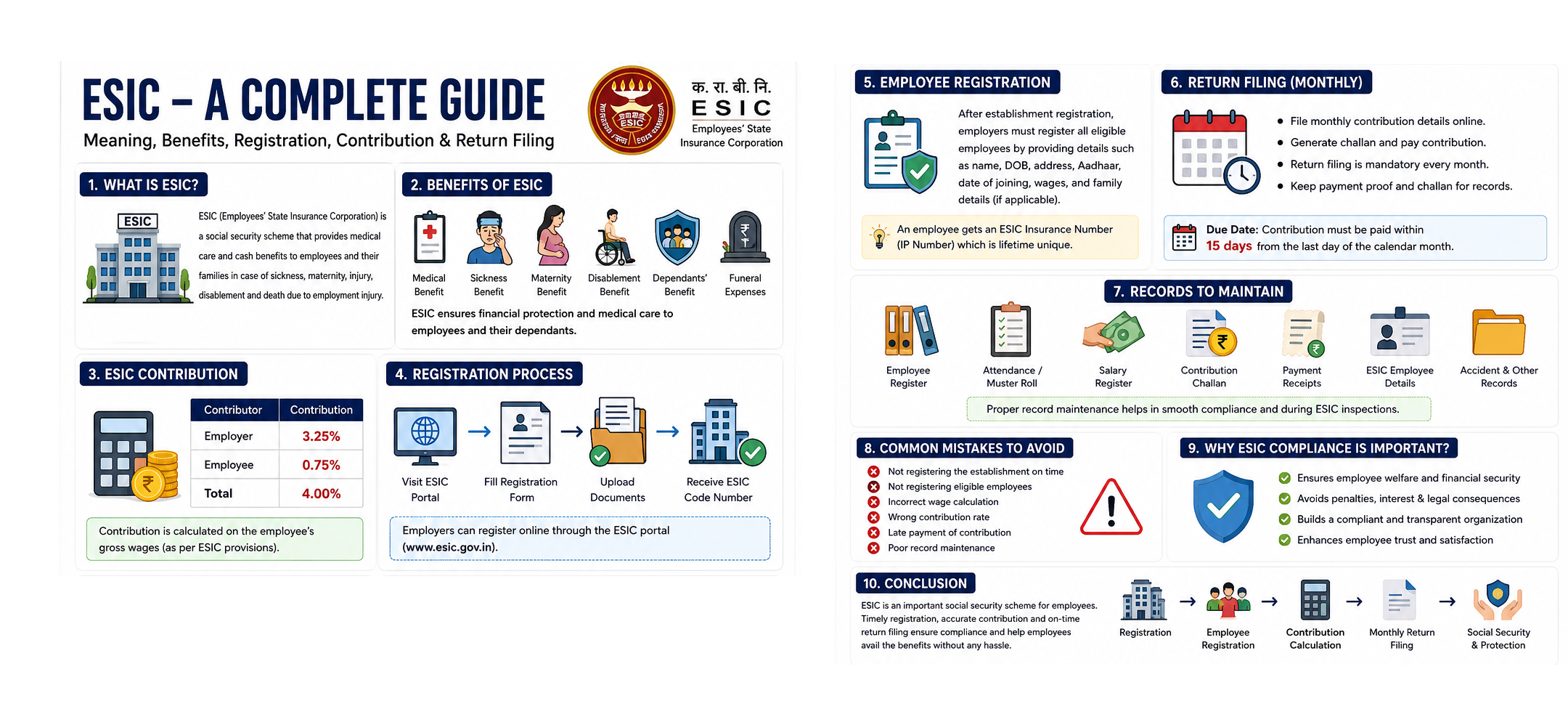
Add a Comment