
INTRODUCTION
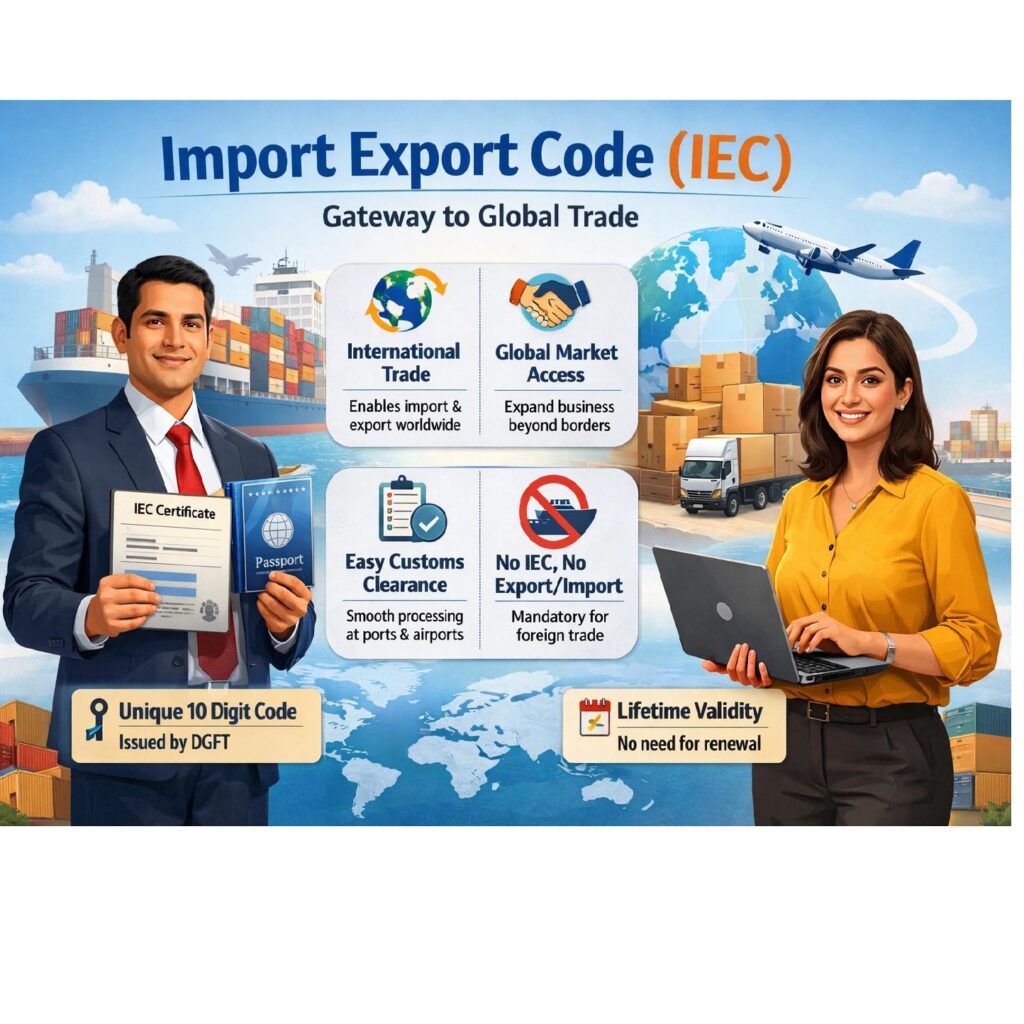
If you are planning to import goods into India or export goods from India, one of the most important registrations to understand is the Importer Exporter Code (IEC).
IEC is issued through the Directorate General of Foreign Trade (DGFT) and is generally required for persons/entities intending to undertake import or export activities, subject to specified exemptions. DGFT’s current guidance continues to identify IEC as the relevant code for import/export and provides an online application process.
WHAT IS IEC CODE?
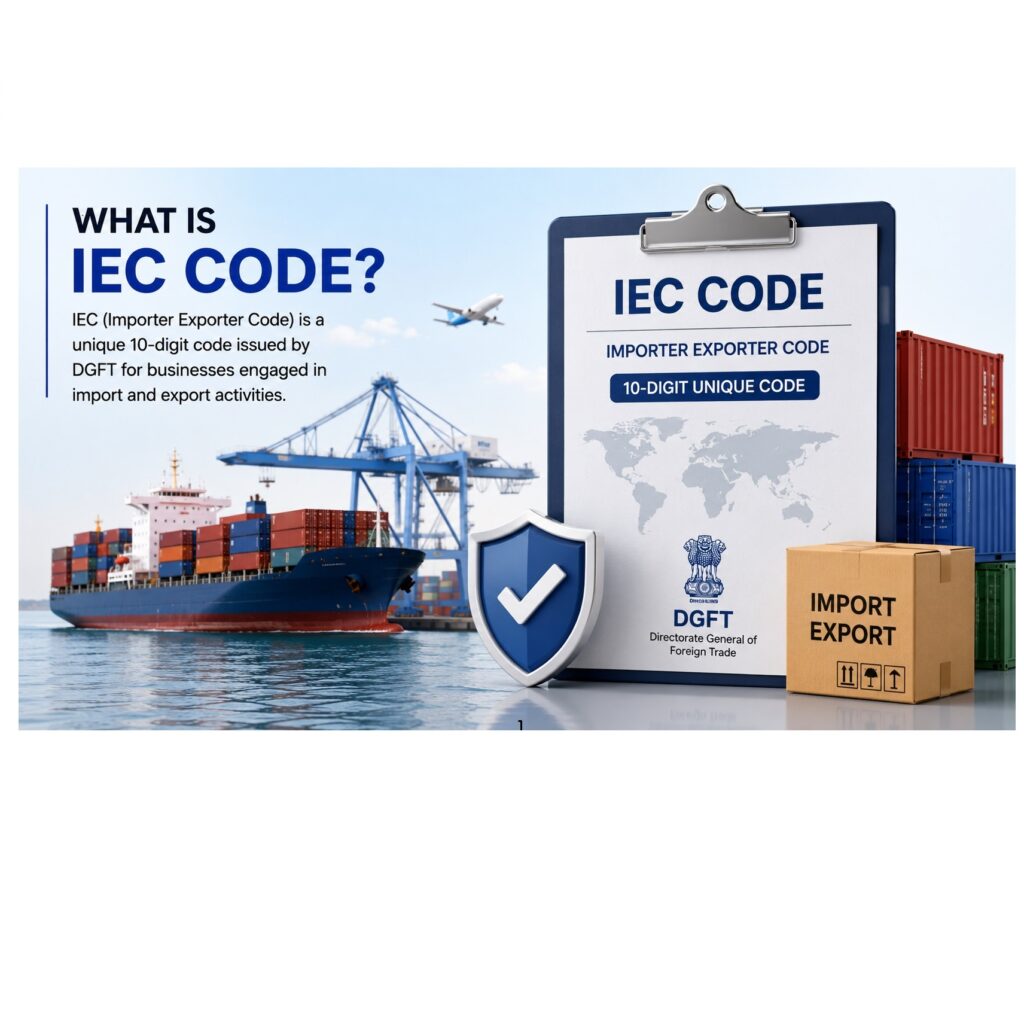
IEC stands for Importer Exporter Code.
It is a unique code issued by the Directorate General of Foreign Trade (DGFT) for persons/entities engaged in or intending to engage in import or export activities.
DGFT’s customs-import guidance describes IEC as a 10-digit alphanumeric code issued on the basis of PAN of an entity and states that the process to obtain IEC is completely online.
WHO NEEDS IEC REGISTRATION?
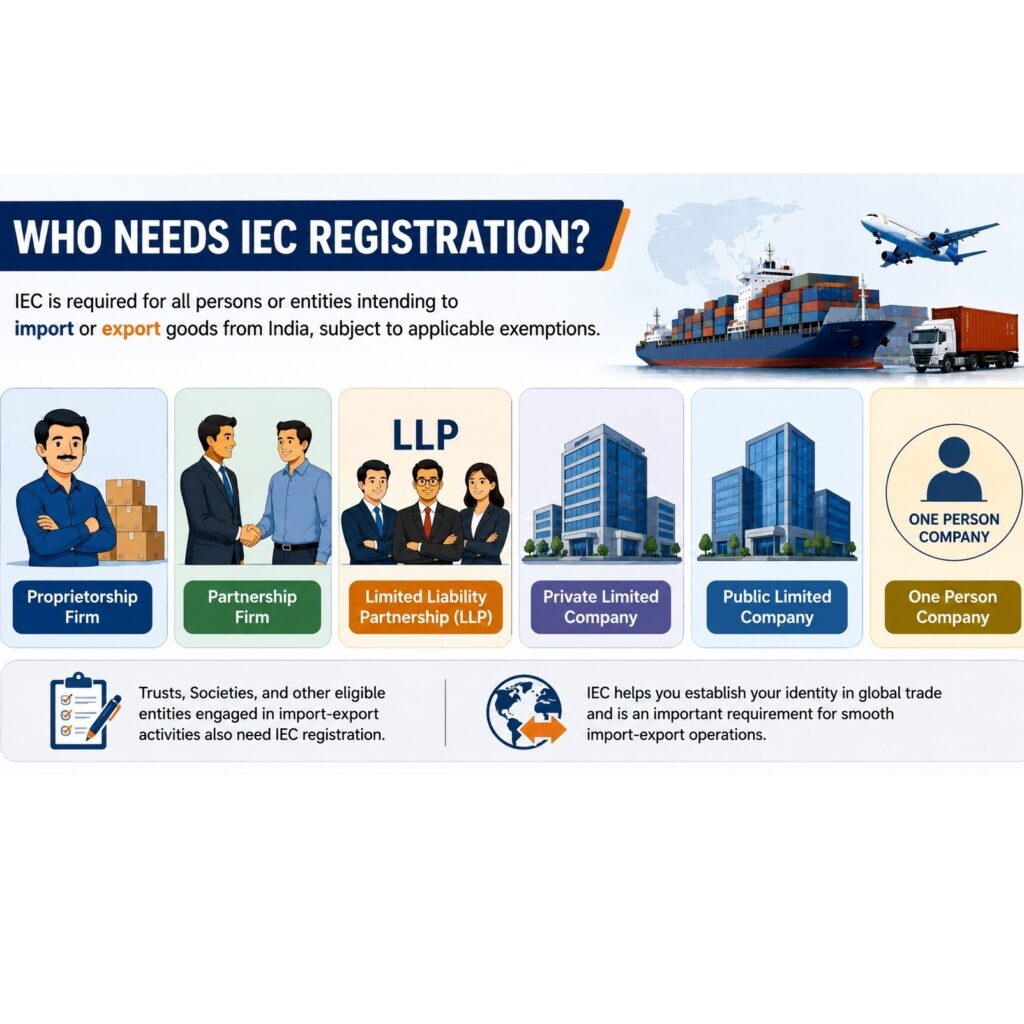
DGFT’s current guidelines state that all persons intending to import or export are required to have an IEC, except categories specifically exempted under the applicable provisions.
IEC may therefore be relevant for:
- Proprietorship firms
- Partnership firms
- LLPs
- Private Limited Companies
- Public Limited Companies
- One Person Companies
- Trusts
- Societies
- Other eligible entities carrying on import/export activities
The exact applicant details and supporting documents depend upon the constitution and circumstances of the applicant.
WHY IS IEC IMPORTANT?
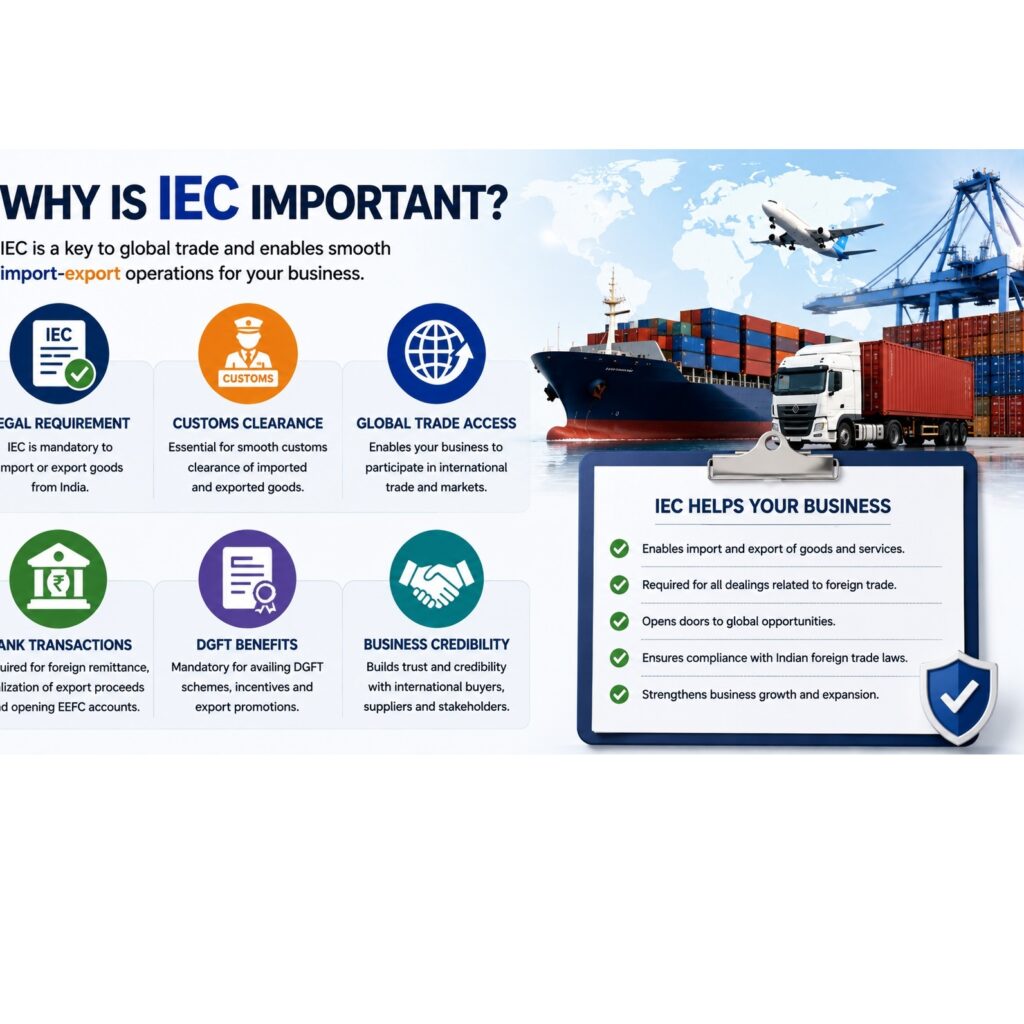
IEC is important because it establishes the identity of the importer/exporter in the DGFT framework.
It can be relevant for:
1. Importing Goods
Businesses importing goods into India generally need IEC, subject to exemptions.
2. Exporting Goods
Businesses exporting goods from India generally need IEC, subject to exemptions.
3. Customs Procedures
IEC is an important part of import/export documentation and customs-related processes.
4. International Trade Compliance
IEC links the business/entity with its foreign-trade profile maintained through DGFT.
5. Export-Related Registrations
An active and updated IEC can also be a prerequisite for certain DGFT-related services.
IEC BASED ON PAN
IEC is linked to the PAN of the entity.
DGFT’s customs guidance describes IEC as a unique 10-digit alphanumeric code issued on the basis of the entity’s PAN.
Therefore, while applying for IEC, the applicant should ensure that the:
PAN details → Applicant details → Entity details → Bank details
are properly aligned.
Any mismatch can create verification or application issues
DOCUMENTS REQUIRED FOR IEC REGISTRATION
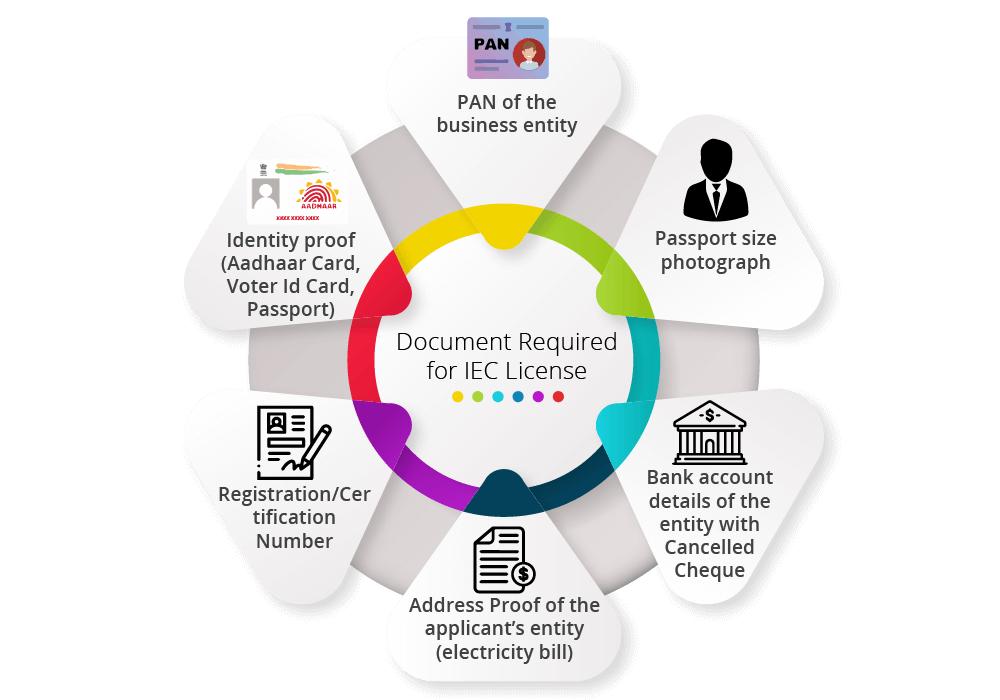
The exact documents depend upon the constitution and information required in the DGFT application.
Commonly relevant information/documents may include:
- PAN
- Address proof of the firm/entity
- Bank account details
- Cancelled cheque or bank certificate, where applicable
- Aadhaar/identity details as applicable
- Mobile number
- Email ID
- Details of proprietor/partner/director/authorised person
- Entity constitution documents, where applicable
IEC REGISTRATION PROCESS – STEP BY STEP
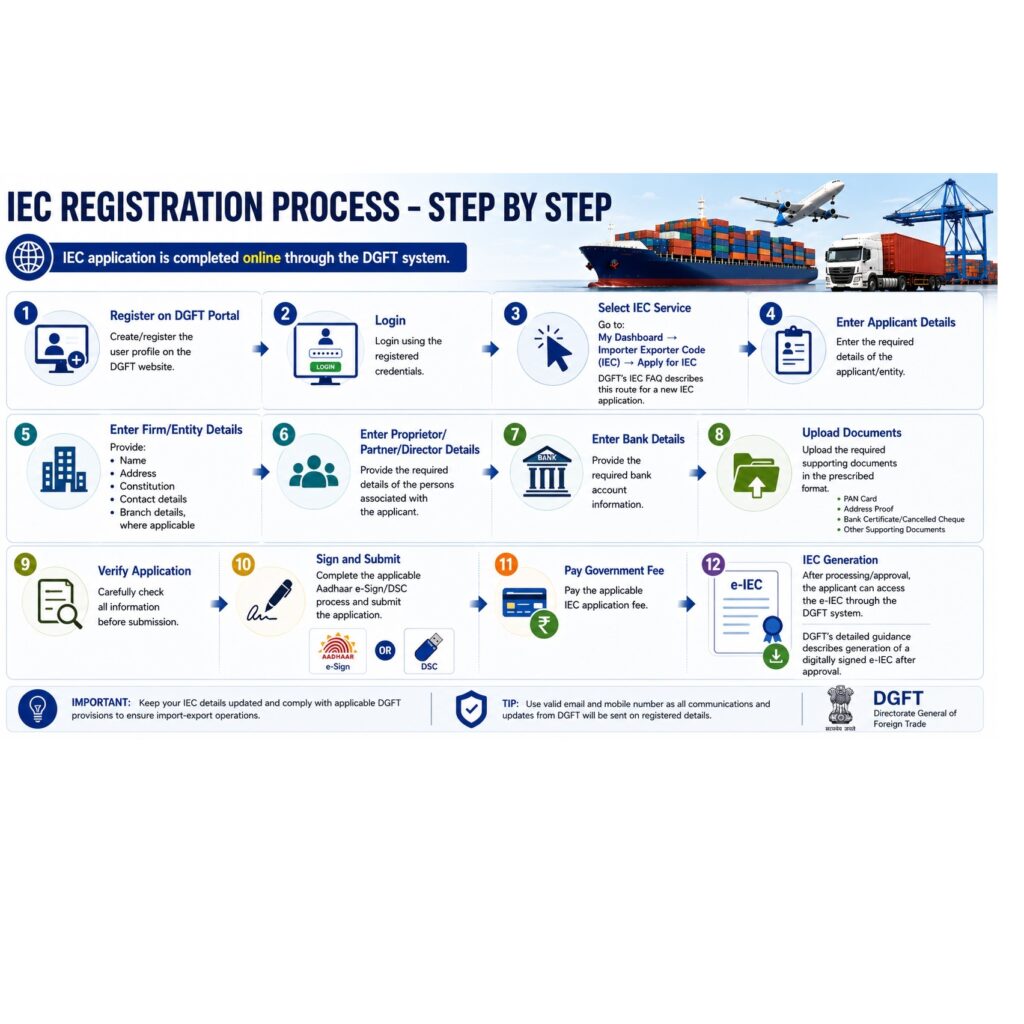
IEC application is completed online through the DGFT system.
Step 1 – Register on DGFT Portal
Create/register the user profile on the DGFT website.
Step 2 – Login
Login using the registered credentials.
Step 3 – Select IEC Service
Go to:
My Dashboard → Importer Exporter Code (IEC) → Apply for IEC
DGFT’s IEC FAQ describes this route for a new IEC application.
Step 4 – Enter Applicant Details
Enter the required details of the applicant/entity.
Step 5 – Enter Firm/Entity Details
Provide:
- Name
- Address
- Constitution
- Contact details
- Branch details, where applicable
Step 6 – Enter Proprietor/Partner/Director Details
Provide the required details of the persons associated with the applicant.
Step 7 – Enter Bank Details
Provide the required bank account information.
Step 8 – Upload Documents
Upload the required supporting documents in the prescribed format.
Step 9 – Verify Application
Carefully check all information before submission.
Step 10 – Sign and Submit
Complete the applicable Aadhaar e-Sign/DSC process and submit the application.
Step 11 – Pay Government Fee
Pay the applicable IEC application fee.
Step 12 – IEC Generation
After processing/approval, the applicant can access the e-IEC through the DGFT system. DGFT’s detailed guidance describes generation of a digitally signed e-IEC after approval.
WHAT IS THE GOVERNMENT FEE FOR IEC?
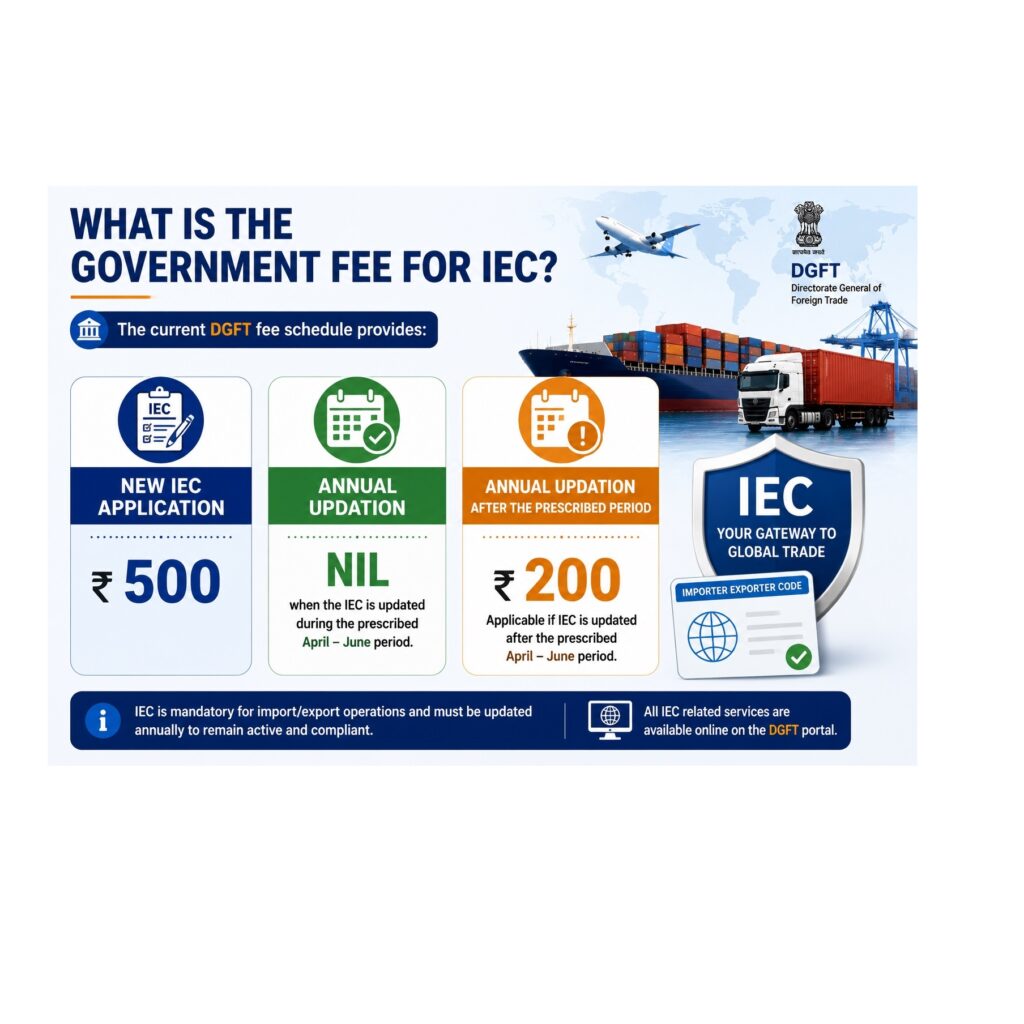
The current DGFT fee schedule provides:
New IEC Application
Rs. 500
Annual Updation
Nil when the IEC is updated during the prescribed April–June period.
Annual Updation After the Prescribed Period
Rs. 200
IS IEC ANNUAL UPDATION MANDATORY?
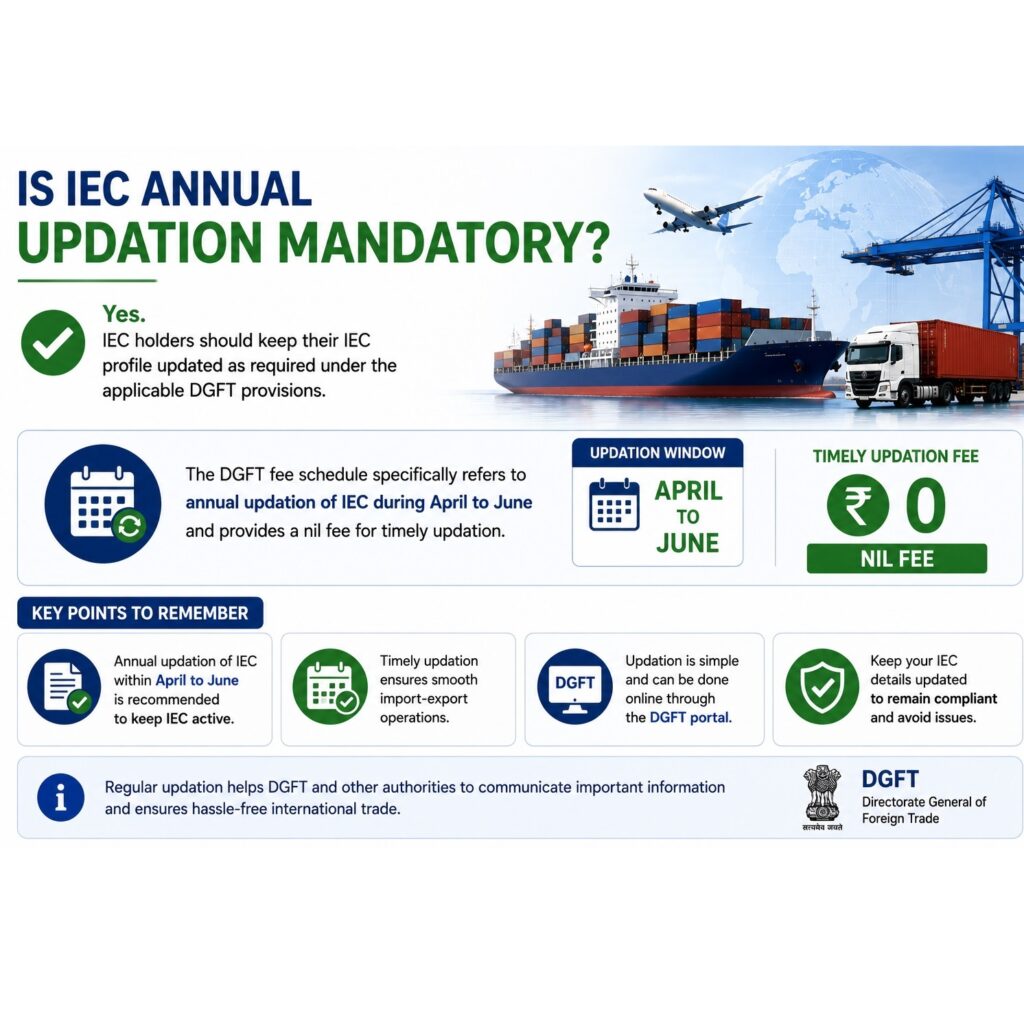
Yes. IEC holders should keep their IEC profile updated as required under the applicable DGFT provisions.
The DGFT fee schedule specifically refers to annual updation of IEC during April to June and provides a nil fee for timely updation.
WHAT HAPPENS IF IEC IS NOT UPDATED?
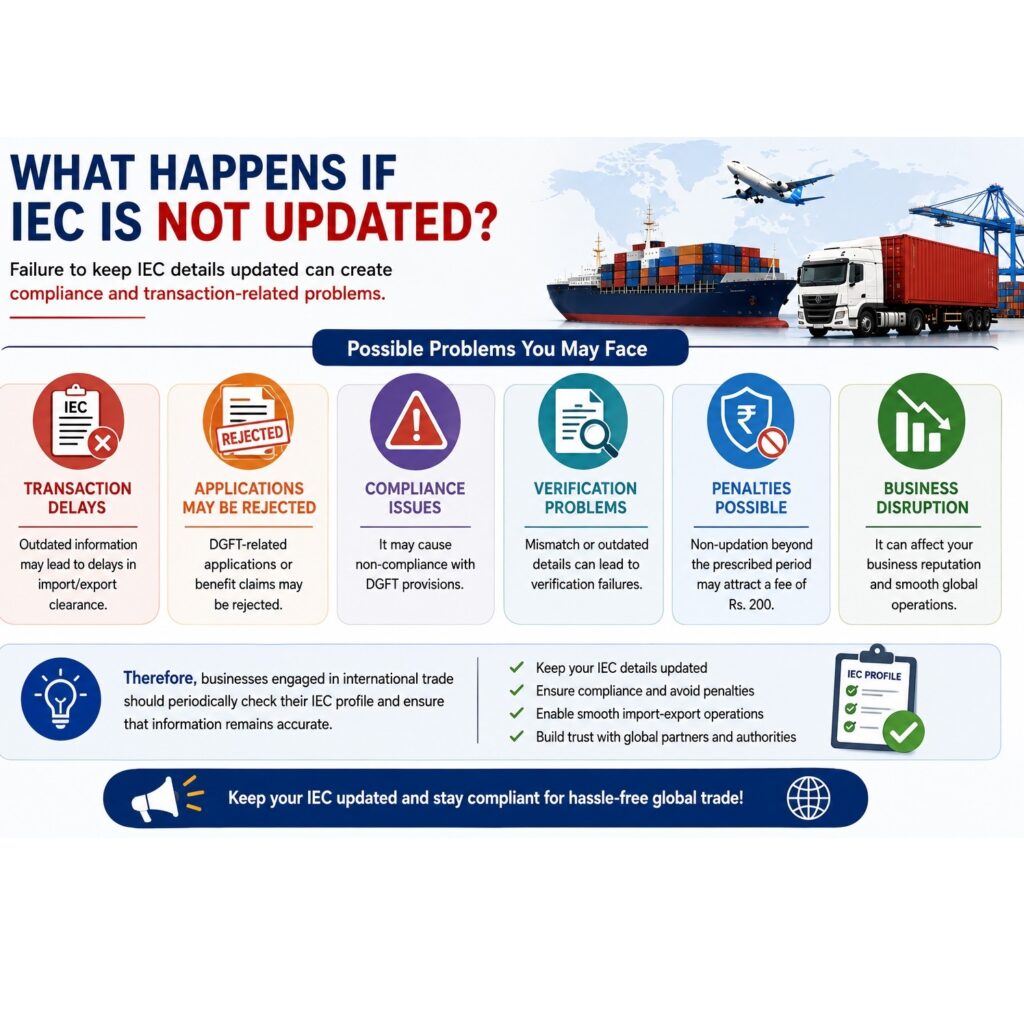
Failure to keep IEC details updated can create compliance and transaction-related problems.
Therefore, businesses engaged in international trade should periodically check their IEC profile and ensure that information remains accurate.
IEC MODIFICATION
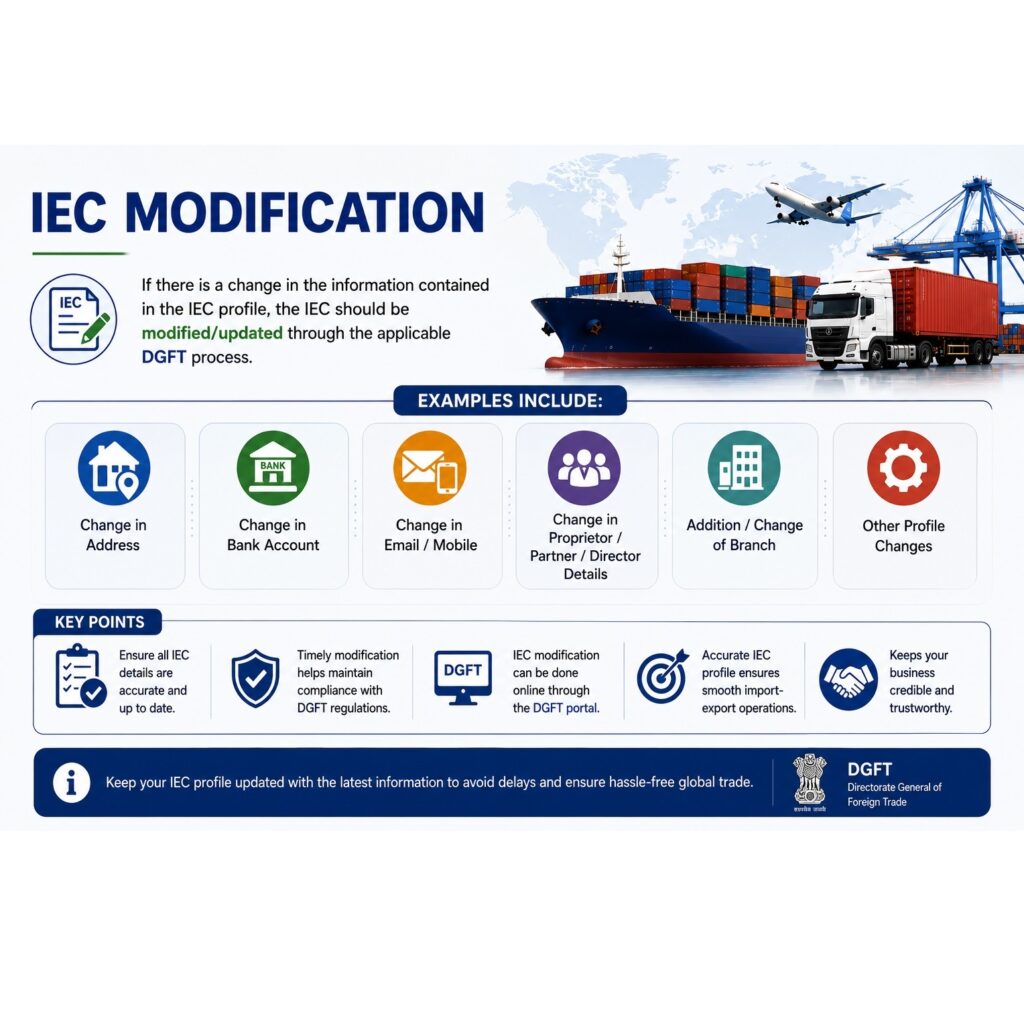
If there is a change in the information contained in the IEC profile, the IEC should be modified/updated through the applicable DGFT process.
Examples include:
- Change in address
- Change in bank account
- Change in email/mobile
- Change in proprietor/partner/director details
- Addition/change of branch
- Other profile changes
CAN ONE BUSINESS HAVE MULTIPLE IECS?
Key Rules for IEC and PAN
- One PAN, One IEC: The Directorate General of Foreign Trade (DGFT) issues only one IEC per Permanent Account Number (PAN).
- Same as PAN: Since the rules were updated, the 10-digit IEC issued to a business is identical to its PAN.
- Multiple Businesses: If a company starts a new product line or a second business under the same PAN and legal entity, it must use the same existing IEC. You cannot apply for a separate IEC for a second branch or division if the PAN remains the same.
- Different Legal Entities: Separate IECs are only allowed if you operate distinct legal entities that have completely separate PAN cards (such as two different private limited companies or separate partnerships)
COMMON IEC MISTAKES
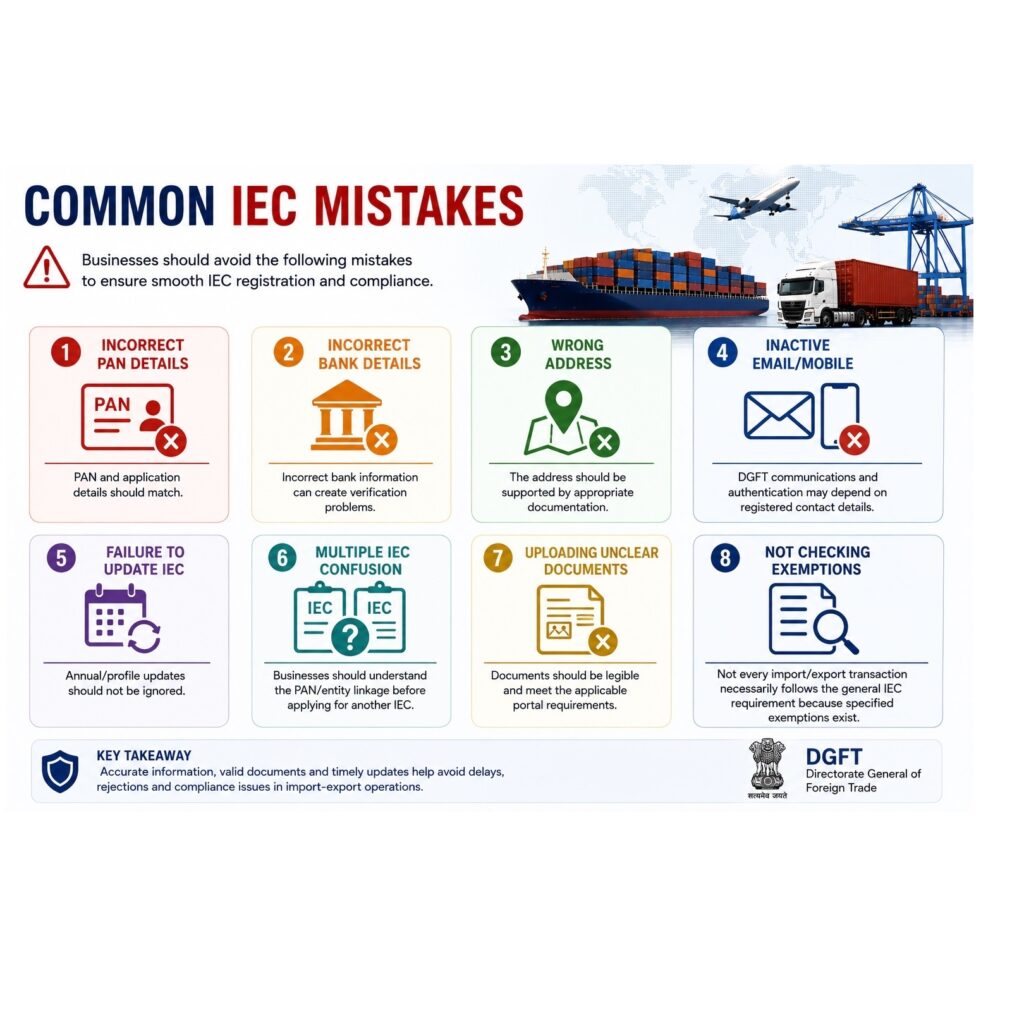
Businesses should avoid the following mistakes:
1. Incorrect PAN details
PAN and application details should match.
2. Incorrect bank details
Incorrect bank information can create verification problems.
3. Wrong address
The address should be supported by appropriate documentation.
4. Inactive email/mobile
DGFT communications and authentication may depend on registered contact details.
5. Failure to update IEC
Annual/profile updates should not be ignored.
6. Multiple IEC confusion
Businesses should understand the PAN/entity linkage before applying for another IEC.
7. Uploading unclear documents
Documents should be legible and meet the applicable portal requirements.
8. Not checking exemptions
Not every import/export transaction necessarily follows the general IEC requirement because specified exemptions exist.
FREQUENTLY ASKED QUESTIONS (FAQS) ON IEC
1. What is IEC?
IEC means Importer Exporter Code, issued through DGFT for persons/entities intending to import/export, subject to applicable exemptions.
2. Who issues IEC?
IEC is issued through the Directorate General of Foreign Trade (DGFT).
3. Is IEC mandatory for import?
Generally, yes, subject to specified exemptions.
4. Is IEC mandatory for export?
Generally, yes, subject to specified exemptions.
5. What is the IEC application fee?
The DGFT fee schedule currently lists ₹500 for an IEC application.
6. Is annual IEC updation required?
Yes, IEC holders should undertake the prescribed annual updation. DGFT’s fee schedule provides nil fee during April–June and ₹200 after the stipulated period.
7. Is IEC the same as GSTIN?
No. IEC and GSTIN are separate registrations.
8. Is IEC required for a proprietorship?
A proprietorship undertaking import/export activities generally requires IEC unless an applicable exemption applies.
9. Can IEC details be modified?
Yes. DGFT provides an online Modify IEC workflow for updating IEC profile information.
10. What happens after IEC approval?
An e-IEC can be generated/accessed through the DGFT system after approval.
11. Is IEC required for every foreign transaction?
Not necessarily. The general IEC requirement is subject to specified exemptions and the nature of the transaction.
12. How long is IEC valid?
DGFT’s customs guidance describes IEC as having lifetime validity, subject to the applicable updation/compliance requirements.
CONCLUSION
The Importer Exporter Code (IEC) is an important requirement for businesses planning to undertake import or export activities in India, subject to applicable exemptions. It provides a unique identification for foreign-trade activities and plays an important role in customs and DGFT-related processes.
Proper IEC compliance can help businesses avoid unnecessary delays and documentation issues while carrying out international trade.
Planning to start an import-export business? Make sure your IEC and other applicable registrations are completed correctly before commencing your foreign-trade activities.
Add a Comment